Alcohol
The Social & Medical Effects and How to Combat Misuse
https://www.humantruth.info/alcohol.html
By Vexen Crabtree 2015
Although alcoholic drinks serve a role in social behaviour, binge drinking, alcohol abuse and addiction cause problems for many individuals, and even moderate drinking has health effects on otherwise healthy people1. Heavy drinking has negative health consequences2,3. Health risks to pregnant mothers' babies4 are well-known. Alcohol misuse causes more than 200 disease and injury conditions in individuals, most notably alcohol dependence, liver cirrhosis, cardiovascular diseases, cancers and physical injuries5,3 plus depression and anxiety3. In total it's "among the top five risk factors for disease, disability and death"5.
National economies also suffer6 via increased health service costs, policing costs and lost days' work. Worldwide, alcohol misuse is "among the top five risk factors for disease, disability and death"5. "In 2012... 5.9% of all global deaths, were attributable to alcohol consumption"7. Deaths from chronic alcohol misuse have been rising for decades, and so has violence, abuse, vandalism and crime all associated with alcohol over-use. The aggression and crime associated with alcohol in some Western countries infringes on the human rights of those who want nothing to do with such behaviour. Many of the social effects of alcohol are psychological and cultural; i.e., people don't have to behave criminally or destructively whilst drunk - it is a culturally learned behaviour. Experiments have shown that behaviour can be controlled: Those who do not wish to behave badly whilst drunk, will not do so.
- International Consumption Statistics
- The Effects of Alcohol
- Social Factors and Effects
- A Brief History of Alcohol Use from Ancient Times to Modern
- Genetics
- National Steps That Can Reduce Alcohol Abuse
- Benefits of the Light Drinking of Alcohol, Especially Wine
- Religion and Alcohol
- Links
1. International Consumption Statistics8
| Alcohol Consumption (2016)9 | ||
|---|---|---|
| Pos. | Lower is better Per Capita9 | |
| 1 | Bangladesh | 0.0 |
| 2 | Kuwait | 0.0 |
| 3 | Libya | 0.0 |
| 4 | Mauritania | 0.0 |
| 5 | Somalia | 0.0 |
| 6 | Yemen | 0.1 |
| 7= | Afghanistan | 0.2 |
| 7= | Saudi Arabia | 0.2 |
| 9= | Syria | 0.3 |
| 9= | Pakistan | 0.3 |
| 11= | Kiribati | 0.4 |
| 11= | Iraq | 0.4 |
| 11= | Brunei | 0.4 |
| 11= | Egypt | 0.4 |
| 15= | Djibouti | 0.5 |
| 15= | Niger | 0.5 |
| 15= | Sudan | 0.5 |
| 18= | Bhutan | 0.6 |
| 18= | Morocco | 0.6 |
| 20= | Jordan | 0.7 |
| q=189. | ||
| Alcohol Consumption (2016)9 | ||
|---|---|---|
| Pos. | Higher is worse Per Capita9 | |
| 169= | Gabon | 11.5 |
| 167= | Slovakia | 11.5 |
| 165= | Switzerland | 11.5 |
| 166 | Hungary | 11.4 |
| 165= | Equatorial Guinea | 11.3 |
| 163= | Andorra | 11.3 |
| 163 | Belarus | 11.2 |
| 162 | Serbia | 11.1 |
| 161= | Uruguay | 10.8 |
| 159= | Cyprus | 10.8 |
| 159= | Finland | 10.7 |
| 157= | New Zealand | 10.7 |
| 157= | Cook Islands | 10.6 |
| 155= | Australia | 10.6 |
| 155= | Laos | 10.4 |
| 153= | Greece | 10.4 |
| 151= | Denmark | 10.4 |
| 152 | S. Korea | 10.2 |
| 151 | Spain | 10.0 |
| 150= | St Lucia | 9.9 |
| q=189. | ||
The data in the charts to the right shows total annual consumption per person aged 15+, in 2010 and comes from the latest World Health Organisation (2014) report on international alcohol consumption. The measurement is of total litres of pure alcohol. The worldwide average in 2010 was equal 6.2 litres10.
It is apparent that the worst rates of consumption is found in Russia and countries that were once part of the Soviet bloc in Europe, followed by a general smattering of other European countries. "In general, the greater the economic wealth of a country, the more alcohol is consumed [and] high-income countries have ... the highest prevalence of heavy episodic drinking"11.
There are some signs of improvement in the global approach towards alcohol. Europe is coming down from its centuries-long bender, and "alcohol per capita consumption (APC) in persons aged 15 years and older [declined globally] by 12% from 5.7 litres to 5.0 litres in 2022. [...] This is remarkable progress [given that it was rising] since 2000s, driven mainly by the rise [in] South-East Asia Region and the Western Pacific Region"1.
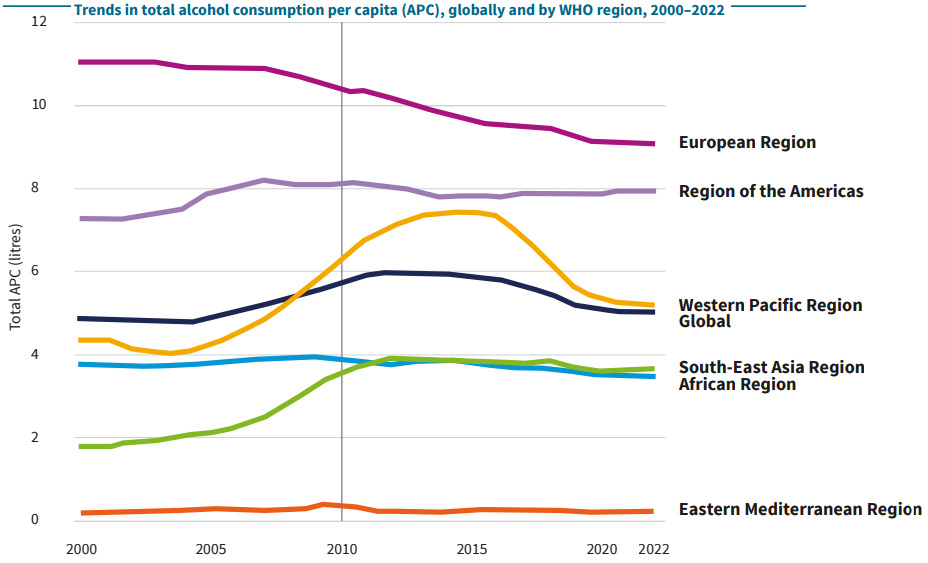
Source: WHO (2025)1
2. The Effects of Alcohol
Immediate effects of alcohol are that it makes you react slower, make worse decisions, impairs the ability to perform accurate tasks, makes you physically less capable, less alert, less co-ordinated and unable to regulate (and sense) body temperature. Drinking when very hot or very cold is suicidal.12. Alcohol makes you feel warm because it causes your capillaries to allow more blood to the surface of the skin; but this also increases the rate that you lose heat through your skin. Despite those degradations, it makes you more confident in making worse decisions.
Reduced Fitness. A British Army publication states the following fitness degradations12:
- Interferes with fitness; heart and lungs work less efficiently
- It damages muscles
- It can lead to increased weight
- It increases the risk of accidents and injuries
- It damages the immune system, making you more prone to infection
- It increases the time needed to recover from injuries and illnesses
- It causes dehydration, making exercise dangerous and unpleasant
Alcohol effects the brain:
“Alcohol kills nerve cells - but in a highly selective fashion. In the January 30, 1981 issue of Science, Charles Golden and his associates report that alcohol tends to destroy brain tissue primarily in the dominant hemisphere. The behavioural changes associated with chronic drunkenness tend to support Golden's findings. For example, the slurred speech, the inability to think logically and to plan effectively, and the emotional outbursts shown by many alcoholics all suggest that alcohol disrupts the dominance normally shown by the left hemisphere. Indeed, Golden and his colleagues believe these symptoms result from the right hemisphere's attempts to take over the functions lost through destruction of tissue in the left hemisphere.”
"Understanding Human Behavior" by James V. McConnel (1986)13
“In older chronic alcohol abusers, a deficiency of B-complex vitamins can cause amnestic syndrome, a severe loss of memory for both recent and long-past events. These memory gaps are often filled in by reporting imaginary events (confabulation) that are highly improbable. [...] Prolonged use of alcohol appears to damage brain cells, especially those in the frontal lobes, causing cortical atrophy and other changes in structure (Parkins, 1975).”
"Abnormal Psychology" by Davison and Neale (1997)14
Cirrhosis of the liver3 is perhaps the most well-known accumulated negative effect of alcohol. Liver cells become engorged with fat and protein, impeding their function; some cells die, triggering an inflammatory process. When scar tissue develops, blood flow is obstructed. This disease is the ninth biggest cause of the death in the USA (1990) and is primarily caused by alcohol overuse15. Alcohol over-use also causes other liver diseases3.
Malnutrition:
“Because alcohol provides calories [...] heavy drinkers often reduce their intake of food. But the calories provided by alcohol are empty; they do not supply the nutrients essential for health. Alcohol also contributes directly to malnutrition by impairing the digestion of good and absorption of vitamins.”
"Abnormal Psychology" by Davison and Neale (1997)14
Other Physiological Effects of drinking alcohol include "risks of developing [non-communicable diseases] such as [...] cardiovascular diseases and different types of cancers, as well as mental health and behavioural conditions such as depression, anxiety and alcohol use disorders. Alcohol consumption also causes significant harm to others, as it can lead to injuries such as those caused by road traffic crashes"3.
“Common physiological changes include damage to the endocrine glands and pancreas, heart failure, hypertension, stroke, and capillary hemorrhages, which are responsible for the swelling and redness in the face, and especially of the nose, of chronic alcohol abusers. [...]
Alcohol also reduces the effectiveness of the immune system, resulting in increased susceptibility to infection and cancer.”
"Abnormal Psychology" by Davison and Neale (1997)14
Drinking during pregnancy harms the fetus. Drinking heavily doubles the chance of miscarriage and increases the chances of major abnormalities16,4. Drinking more than 8 units a week causes fetal alcohol syndrome16, but some demographic and genetic groups are more at risk than others17. It's not clear where the line is18 but risk-averse official advice often states that the safest approach is not to drink alcohol at all during pregnancy18,16. Others advise small amounts - one or two units, once or twice a week16,18.
“Heavy alcohol consumption during pregnancy is the leading known cause of mental retardation. The growth of the fetus is slowed, and cranial, facial and limb anomalies are produced. The condition is known as fetal alcohol syndrome. Even moderate drinking can produce less severe but undesirable effects on the fetus, leading the National Institute on Alcohol Abuse and Alcoholism to counsel total abstention during pregnancy as the safest course.”
"Abnormal Psychology" by Davison and Neale (1997)14
Family Alcoholism and the Effect on Children: See the later section on this topic.
3. Social Factors and Effects
3.1. Alcohol, Crime and Violence
"Almost half of all victims of violence report that perpetrators were under the influence."15
"The role of alcohol in combination with other drugs should not be ignored. Violence seems to be more closely linked with excessive intake of alcohol than with many illegal drugs [...] - though there is room to argue that this is a culturally mediated effect rather than a necessary effect of alcohol."20
"Over 50% of men convicted of sexual assault and rape had been drinking prior to the attack. An equally high proportion of victims of rape had themselves been under the influence of alcohol at the time of the attack"12
There was one allusion above to the fact that the social effects of alcohol are cultural. This is discussed later.
3.2. Case Example of a Country Going Wrong: Increasing Alcohol Abuse in the UK
#alcohol #alcoholism #binge_drinking #british_culture #drinking #france #italy #pub_culture #trash_culture #UK #UK_health
The UK has seen a 50-year growth in alcohol consumption and it has become a public-health crisis21. In 2007-8 it directly cost the NHS £3 billion21, and overall the national cost is up to £55 billion a year21,22. Across 2007-8, the UK had up to 40,000 alcohol-related deaths, including 350 from acute alcohol poisoning and 8,000 from cirrhosis of the liver21. Consumption has doubled since the late 1950s, whilst in other developed countries such as France and Italy, it has more than halved23; liver disease rates are falling in the EU, but the UK's rises24. The price of alcohol is half what it was in the 1970s23,15. Between 1995 and 2001, binge drinking increased by 35% in the UK23 . The increase in drinking "is reflected in rising death rates from chronic liver disease, the primary cause of which is too much drink", and the UK has some of Europe's worst rates of childhood drunkenness and several thousands of babies are born each year with foetal alcohol syndrome21, which has lifelong effects.
For more, see:
3.3. Parenting8
#alcohol #children's_health #parenting
Excessive alcohol consumption while parenting is the basis for many bad habits later in life 25, with a combination of culture, genetic susceptibility and family habits creating risk26. In some localized high-risk social bubbles official intervention can be required, to safeguard the child25. Statistically, children who grow up in alcoholic households have a much higher tendency to either become teetotal (drinking almost no alcohol) or, the opposite, becoming alcoholic themselves.
Public Health England25 reported in 2013 that parental behaviour is the basis for many bad habits later in life, specifically mentioning excessive alcohol consumption, and stating that prevention and early intervention are both much better than trying to reverse learned bad behaviour25. The World Health Organisation pointed out in 2014 that:
“A family history of alcohol use disorders is considered a major vulnerability factor for both genetic and environmental reasons. [...] Parents with alcohol use disorders ... increase the likelihood that their children will develop drinking patterns associated with high risk of alcohol use disorders when they are introduced to alcohol. Heavy drinking by parents affects family functioning, the parent-child relationship and parenting practices, which in turn affects child development adversely.”
"Global Status Report on Alcohol and Health" by World Health Organization (2014)26
Children of alcoholic parents have polarised reactions to alcohol:
“The findings by Valliant (1983) show that children who grow up in households with an alcoholic parent are as a group on average as likely to become teetotal as develop alcohol problems. [...] Crabbe and Goldman (1992) concluded that: 'As children growing up in alcoholic households have an increased risk of becoming either alcoholic or abstinent, it seems that increased risk of alcoholism depends partly on how a person reacts to his or her environment.”
"Chaos and Intoxication" by Alan Dean (1997)27
3.4. The Behavioural Effects of Alcohol are Socially Learned
Whether people become 'addicted' to alcohol or not is partially dependent on genetics; but upbringing and choice play a larger part.
“The evidence presented [...] demonstrates clearly that physiological and biochemical responses to alcohol and drug use are at least in part inherited. A wide range of evidence, from adoption and twin studies to the identification of biological markers for responses to drug and alcohol use, have supported the findings that certain traits associated with use are inherited.”
"Chaos and Intoxication" by Alan Dean (1997)28
Our behaviour when drunk is a function of our character and our expectations about 'how drunk people act'. In cultures and paradigms where alcohol-fuelled violence (such as fighting in a pub or attacking the spouse) or crime (such as street vandalism and destructive behaviour), is not seen as the result of alcohol, then, drunk people do not behave in that way. In other words, to prevent petit crime associated with alcohol you could simply educate people, and get them to internalize, the truth that drunken behaviour isn't intrinsically violent. They could then learn to control themselves whilst drunk. This shows that alcohol-inspired drunken behaviour is psychosomatic. A series of experiments in the 1970s provided supporting evidence.
“It appears that some of the short-term effects of ingesting small amounts of alcohol are as strongly related to the drinker's expectations about the effects of the drug as they are to its chemical action on the body. For example, alcohol is commonly thought to stimulate aggression and increase sexual responsiveness. Research has shown, however, that these reactions may not be caused by alcohol itself but by the drinker's beliefs about alcohol's effects. In experiments demonstrating these points, participants are told that they are consuming a quantity of alcohol when they are actually given an alcohol-free beverage with its taste disguised. They subsequently become more aggressive (Lang et al., 1975) and report increased sexual arousal (Wilson & Lawson, 1976). People who actually drink alcohol also report increased sexual arousal, even though alcohol makes them less aroused physiologically (Farkas & Wilson, 1976). Once again, cognitions have a demonstratably powerful effect on behaviour.”
"Abnormal Psychology" by Davison and Neale (1997)29,30
The 1980s saw further research complement and reinforce the evidence that expectation and assumption about drunken behaviour is an important cause of that behaviour:
“In the 1980 book Advances in Substance Abuse, G.A. Marlatt and D.J. Rohsenow report that most of the "social effects" of alcohol may be due to people's expectations about the drug. Subjects who drank tonic water but thought it was alcohol showed most of the 'classic' symptoms of intoxication, while subjects who drank alcohol but thought it was tonic water failed to get "high". [...]
Marlatt and Rohsenow also tested alcoholics by giving them tonic water but telling them it was vodka. The alcoholics experienced the same "craving" for more alcohol after drinking the tonic water as they typically did when consuming alcohol. They did not report this craving after drinking vodka they thought was tonic water.
Marlatt and Rohsenow conclude that the setting in which alcohol is consumed and the drinker's expectations are even more influential in determining the drinker's reactions than are the physical effects of the alcohol itself.”
"Understanding Human Behavior" by James V. McConnel (1986)31
From the 1990s, the Home Office Drugs Prevention Office has been investigating the behaviour of drugs and alcohol users. They comment that:
“The role of alcohol in combination with other drugs should not be ignored. Violence seems to be more closely linked with excessive intake of alcohol than with many illegal drugs [...] - though there is room to argue that this is a culturally mediated effect rather than a necessary effect of alcohol.”
"Drugs Misuse and the Criminal Justice System" by Prof. Michael Hough32
Placebo experiments in the 1970s on the effects of fake alcohol consumption, in the 1980s on the psychology of expectation and in the 1990s on criminal behaviour have all found that peoples' reactions to alcohol are partially determined by what they think the effects of alcohol should be, especially when it comes to crime and aggression. To curb street violence, increased education on what the effects of alcohol really are is required, and so is changing the nature of the environment in which alcohol is drunk (and especially where binge-drinking occurs). Both of these things require a change of the basic, common drinking habits of those who frequent pubs.
3.5. Misc
Men are five times as likely to become alcoholic as women33.
"Worldwide about 16.0% of drinkers aged 15 years or older engage in heavy episodic drinking"34 (binge drinking).
"Binge drinkers are 14 times more likely to drive while impaired compared to people who drink sensible amounts"15.
"Alcohol consumption also causes significant harm to others, as it can lead to injuries such as those caused by road traffic crashes."3
Friedrich Nietzsche's four great idols of thinking errors included the error of confusing cause and effect. In Aphorisms 1 and 2 of "Twilight of the Idols" (1888)35, he states that people think that rampant alcoholism destroys societies, but in fact, he states, societies-in-decline in fact simply turn to alcohol36. The reality of course is much more complex, with all strata of society reacting in different ways to various pressures.
4. A Brief History of Alcohol Use from Ancient Times to Modern8
Intentionally brewing alcoholic foodstuffs has been part of human culture for such a long time that we have genetically adapted to it37.
“The use of alcoholic beverages has been an integral part of many cultures for thousands of years. Prior to the modern era, fermented alcoholic beverages were known in all tribal and village societies except in Australia, Oceania and North America. In societies where there was no aboriginal alcohol consumption, the encounter with alcoholic beverages was often abrupt and highly problematic. Where alcohol was traditionally consumed, production of alcoholic beverages commonly occurred on a small scale as a household or artisanal activity, particularly when and where agricultural surpluses were available. Drinking alcohol was thus often an occasional and communal activity, associated with particular communal festivals. There are many places in the world today where versions of these traditional patterns originating from tribal and village societies persist.
[Commercial] production and consumption ... developed in European empires ... during early modern industrialization. ... This increased supply and availability often proved disastrous for indigenous economies and public health [and] often catastrophic elsewhere in the world. By the nineteenth century, leaders of industry were viewing alcohol as a major impediment to industrial livelihoods.”
"Global Status Report on Alcohol and Health"
World Health Organization (2014)38
5. Genetics
“There is a genetic component to alcoholism, for example, which has been proved by Danish studies that have shown that the sons of alcoholic fathers have the same elevated risk of developing alcoholism whether they stay with their natural father or are adopted by non-drinkers.”
“Data [indicates] that problem drinking in human beings runs in families, suggesting a genetic component. Several studies have shown that relatives and children of problem drinkers have higher than expected rates of alcohol abuse or dependence. Twin studies have revealed greater concordance for alcohol abuse [...] in identical twins than in fraternal twins, pointing again toward a possible role of heredity.[...] Adoption studies add further supports for the importance of a genetic diathesis in both alcohol and drug abuse.
Some ethnic groups, such as Asians, may have a low rate of alcohol abuse because of their physiological intolerance, which is caused by an inherited deficiency in an enzyme that metabolizes alcohol. About three-quarters of Asians experience unpleasant effects from small quantities of alcohol. Noxious effects of the drug may then protect a person from alcohol abuse.”
"Abnormal Psychology" by Davison and Neale (1997)40
“It's certainly true that most societies throughout history have brewed some sort of alcoholic drink, and that this has been part of the human diet for so long that many of us are genetically adapted to consume alcohol. When ethanol breaks down in the body it produces acetaldehyde, a substance even more toxic than alcohol, which needs to be oxidised to avoid unpleasant and dangerous effects. People from ethnic groups who don´t have a history of alcohol use - such as Native Americans, Inuit, and many Chinese - often have a form of the ALDH2 enzyme (the enzyme that breaks down acetaldehyde) which is less effective at this oxidation process, leading to high levels of acetaldehyde in their system when they drink. The resulting facial flushing, nausea, headaches and general discomfort largely outweigh the pleasant effects of intoxication, and by and large these groups drink less alcohol than groups who have a more active form of the enzyme (as most Europeans, Africans and South Americans do), and suffer less alcohol addiction and liver disease.”
6. National Steps That Can Reduce Alcohol Abuse
#alcohol #health #public_health
The most important and effective way to reduce national alcohol consumption is to increase its price41,42,15,43,44, and reduce its availability41,42,15,44. These cost-effective measures in particular have also been shown to reduce car accidents, liver disease, violence and crime42. Given that prevention is better than cure, and younger adults and teenagers are the most sensitive to price hikes15, increasing the cost of alcohol helps to stop addiction at the best age to do so. Clever marketing increases alcoholism44, and therefore, a standard family-friendly route to curb abuse is to make it illegal to broadcast alcohol advertisements before the national watershed.
Specific interventions can be made against specific problems. A method to reduce antisocial behaviour at night in public spaces is to preventing the sale of alcohol from shops past (for example) 9pm. Setting very low blood alcohol limits for driving15 both saves lives and also reduces alcohol consumption among drivers42 and creates a culture where alcohol is treated more sensitively. It is noteworthy that many of these measures could be unpopular and "require real leadership from government" and "a willingness to stand up to criticism from both the drinks industry and the tabloids"45.
For more, see:
7. Benefits of the Light Drinking of Alcohol, Especially Wine
“Tantalizing evidence suggests positive health benefits for some people. Light drinking (fewer than three drinks a day), especially of wine, has been related to decreased risk for coronary heart disease in both men and women.”
"Abnormal Psychology" by Davison and Neale (1997)14
The World Health Organisation reports that the least problematic way to drink alcohol is with food46, in sensible quantities.
“Research has indicated that people who regularly drink very modest, sensible amounts of alcohol tend to live longer, and enjoy better health, than either abstainers or those who abuse alcohol. Drinking more than the recommended limits can drastically reverse those benefits and greatly increase the risks of disease and death.”
"Alcohol And Drugs", British Army publication12
8. Religion and Alcohol 47
Traditional religion often took a cultural commodity such as alcohol, and weaved it into religious story, and ritual, claiming it for itself. Sumerian texts 4,000 years ago describe brewing as a divine act in the Hymn to Ninkasi, and texts at Ur, Lagash and Nippur have the people come give beer to the gods and goddesses, paving the way for religion-approved fermentation. Egyptian pyramid texts (approx 2400-2300 BCE) done the same, and the Rig Veda (1500-1200 BCE) praises the soma alcoholic drink's place in rituals. The Hittite's (1400-1200 BCE had wine mentioned in their religious texts, often as an offering, and then it found place in the Bible from 1000 BCE onwards.
Over the years, many have wanted to step back from alcohol. Religion, again, rose to the occasion, producing variants of holy stories where alcohol was deemed bad for humanity, after all. Instead of using religion to endorse it, many instead herald religion as the solution to the problems of alcohol.
Social pressure can help drive abstinence, and, religion can provide that pressure. "Making public declarations of abstinence, as part of a religious or social group, can create strong social motivations to stay away from drugs"39. In Salt Lake City, USA, irrationalism has led to a suppression of drinking throughout the city "thanks to a Mormon-dominated city council, drinking laws are finicky. If you want to booze without eating, you can either buy extra-watery beer or join a private club"48.
“Bahai's are admonished to abstain from alcohol and drugs, aside from their prescriptive use in remedies by a physician. These substances impede the process of clear thinking and, what is more, their abuse is at the root of many diseases of the body and mind.”
"The Bahá'í Faith" by Joseph Sheppherd (1992)49
But it doesn't always work. Methodists, in theory, are supposed to abstain from alcohol50, too. But that's a surprise to many who actually know methodists. Sometimes, the relationships between religious communities are alcoholism hints that things are not well, overall. For example, there's twice as many Catholic alcoholics in Western countries than you'd expect by chance (2002)51. Throughout the Middle East where Muslims are strictly forbidden by Islam to drink alcohol, but where it is low-key permitted for foreigners as long as they do it in their own hotels and workplaces, every evening there is a throng of temporary pretend Westerners drinking in hotels to which they do not belong. Such abuses are well-known52.
In order to develop self-control and sensible living, it is best for religion to warn against abuse of alcohol, but not to push total abstinence - which itself drives up secret alcohol use. Culture-wide bans to not give individuals any chance to develop self-control nor experience what sensible usage looks like.