Marriage: Its Diversity and Character
https://www.humantruth.info/marriage.html
By Vexen Crabtree 2026
#afghanistan #arranged_marriages #divorce #family #gypsies #love #marriage #mormonism #religion #romance #sexuality #USA
“Marriage shall be entered into only with the free and full consent of the intending spouses.”
The Universal Declaration of Human Rights Article 16.2
But it's not all good news. But marriage has also been used in ways that undermine dignity and human rights. Strict cultural norms can pressure people into unions they do not want, and forced marriages with no consent and child marriages can amount to slavery, especially for young women. The UN in 2017 reported that "about 15 million girls a year marry before age 18"5. The resultant coercion, abuse and loss of autonomy are direct assaults on Human Rights. Religious rules that forbid marrying outsiders can fuel discrimination, xenophobia and violence. In the Middle East, for example in Afghanistan, "women are regarded as property of men [with] marriages... used in a way to end tribal feuds, to cement alliances between clans, or to increase a family's prestige"6. In some regions, rejecting a forced marriage or seeking divorce can lead to family-based or communal 'honour' killings. Under-age marriage denies children the ability to make informed choices about their own lives, and historically, marriage has been used to control women's sexuality, labour, and freedom. These practices show how marriage, when stripped of consent and equality, can become a tool of oppression rather than a celebration of human connection.
Even though we tend to accept only what we are accustomed to, the diversity of marriage shouldn't be quashed by local sensitivities: within the confines of human rights and guarding against abuse, governments should endeavour to allow all forms of marriage7. Whether centred on romance, family strategy, economic cooperation, or communal expectations, these varied forms of marriage illustrate the flexibility of human relationships and the many ways people create enduring bonds.
- Forms of Marriage
- Differences of Opinion
- Western Marriage
- Religion and Marriage
- Gay Marriage
- Marriages are Convenient (long-term benefits)
- Marriage Rates in the UK
- Divorce Statistics
- Links
1. Forms of Marriage
#love #marriage #religion #romance #sexuality
1.1. Romantic Marriage
Two people have met and have a growing friendship, complete with physical attraction and compatibility of character and interests. They start a relationship, and privately consider that one day they might get married. They may move in with each other after a while, and may get engaged in advance of getting married. Every step is their own choice to assent and continue. Their families and friends can exert informal pressure, but ultimately, the new couple proceed as they wish. This kind of 'romantic marriage' is common throughout the world. In most western countries, it is so institutionalized that no other forms of marriage is considered valid, and most other forms are illegal.
The best feature of romantic marriage is the pure expression of individual love1 and free will. The worst feature is the same: our desires come and go, and so, romantic marriages need bolstering through the legal framework of marriage, which makes it hard to divorce on a whim. The most vocal critics of romantic marriages are those from cultures that engage in some form of arranged marriage; accusing western romantic marriage to be silly, indulging the immature emotions of short-sighted pleasure seekers. And any notion of women choosing men has been angrily resisted by cultures within Christian or Islamic cultures that accepted a male-dominated family model. Cultural norms often translate into legal norms.
1.2. Pragmatic and Arranged Marriage
Pragmatic Marriage is a marriage that is made possible by formal procedures of family or group politics. A responsible authority sets up or encourages the marriage. The authority could be parents, family, a religious figure or a consensus.1. The former two often start the process with informal pressure, social pressure, whilst the latter two often start the process with a formal system or statement. In both cases, the authority has a compelling veto over the marriage, and this system is socially supported by the rest of community so that to deny it is extreme and drastic. Arranged marriages are a form of pragmatic marriage. Once declared, an engagement is implicit, which follows through with a formal marriage ceremony. Those who uphold pragmatic marriage frequently state that it is traditional, that it upholds social morals, that it is good for the families involved.
Pragmatic marriage is said to be traditional, upholding of social morals, and good for the families involved for pragmatic reasons.
Good for family or inter-group relations at the expense of short-term individual empowerment
Devotion to permanent long-term relationship but at the cost of short-term problems during acclimatisation.
Romance cultures see arranged marriages as inhuman, cold and oppressive, even though the actual couples normally feel free and happy (unless 'corrupted' by Western notions). The success rate of pragmatic marriages is very high indeed. Nearly all couples learn to love and care for each other very deeply. It is just that the long-term happiness and stability is given more importance than the short-term. This applies also to marriages that are arranged as a means of increasing the financial stability of a family or the political cohesion of groups.
1.3. Forced Marriages8
#hinduism #human_rights #india #marriage #Pakistan #slavery
Forced marriages are where one partner has no choice at all and are an insult to human rights and human dignity. Women - normally young adults and sometimes adolescents - are the most at-risk group, especially when they are also poor or members of marginalised groups9. At worst, it is slavery and it often involves sexual abuse. Due to its violation of Human rights, forced marriages are outlawed in Europe and in many countries that respect human rights. "The Council of Europe has condemned forced marriages in Resolution 1468 (2005) on Forced Marriages and child marriages proposing specific measures to be taken by its Member States to eradicate this practice"10. Europe has the lowest prevalence of forced marriages in the world11.
Forced marriages contravene Article 3 of The Universal Declaration of Human Rights ("Everyone has the right to life, liberty and security of person") and Article 4 ("No one shall be held in slavery or servitude"). But most of all it directly contradicts Article 16.2:
“Marriage shall be entered into only with the free and full consent of the intending spouses.”
The Universal Declaration of Human Rights Article 16.2
The practice is most prevalent in Arab states12 but across the world, softer forms of arranged marriages are more common. For example, "in traditional Hindu culture, as in Indian culture generally, it is normally considered the responsibility of the parents and family to find suitable spouses for the sons and daughters of the family. [...] The family astrologer will often be asked to examine the couple's horoscopes, and if they are compatible, to choose a suitably lucky day for the ceremony to take place"13. The worst place in the world for it appears to be Pakistan, where over 1,000 women are murdered each year in 'honour' killings, largely for either shunning a forced marriage from when they were pre-teen, getting a divorce, or having a non-arranged boyfriend14.
For more, see:
1.4. Poly, Polgamy, Polyandry
#islam #love #marriage #mormonism #poly #polyamory #relationships #sexuality #USA
The sexuality referred to as poly, polyamory, or "being poly", is the acceptance of the potential for multiple loving partners within relationships. This may include sexual partners. Polyamorous relationships are not "cheating", but mutual love and honesty in relations that are not monogamous. The bases of such relationships are love, stability, compatibility, peace and honesty. Polyamory does not accept secret lovers: this is cheating by poly as well as monogamous standards. Excepting youthful "experiments", which are often just short-term promiscuity and unstable, gender-equal poly relationships are rare for Human Beings. Most Western cultures and religions are strictly (or at least legally) monogamous.
For more, see:
In the West polygamy, the marriage to more than one person, is often illegal. The crime is called 'bigamy'. This illegality is morally wrong and is merely a case of proponents of one type of marriage stamping out other forms that they do not understand for predictable reasons of ignorance and bias.
Many religious groups and cultures have practiced polygamy, from major religions such as Islam and some Arab countries, to communistic communes in the USA such as the Oneida Community3, the Mormons (historically, they do so no longer), and many others. Unfortunately in some of its incarnations it has also been misogynistic and oppressive, but modern-day polyamory in Western countries is not so. In places and communities where polygamy it is accepted, most adults choose to remain in monogamous relationships.
“Polygyny (long-term simultaneous unions between one man and multiple wives) is legal in some countries today, and polyandry (long-term simultaneous unions between one woman and multiple husbands) is legal in a few societies. In fact, polygyny was accepted in the great majority of traditional human societies before the rise of state institutions. [...] Even in officially polygynous societies most men have only one wife at a time.”
"Why is Sex Fun? The Evolution of Human Sexuality" by Jared Diamond (1998)2
The West has adopted a model where monogamy is the only accepted norm for marriage for the last 400 years, but in history, such exclusive legalism is rare. As Western society prides itself on its post-enlightenment tolerance and compassion, its attitude towards marriage is strangely illiberal: Only romantic marriage is seen as "right". In an increasingly multicultural West, however, I foresee future decades where all forms of marriage come to be widely accepted and legalized.
1.5. Gypsy Marriage
#gypsies #marriage #sexuality #UK
Gypsy marriage is different to the Western mainstream. They often have no legalistic documents such as marriage certificates. Although things have largely changed, traditional Gypsy marriage was done between twelve and sixteen, and definitely before 18. The bride is normally the oldest and wisest, and helps the groom in all areas as he learns to earn money for himself. Thus the marriage is more than it is in mainstream Western culture: it serves as a connection between the clan-like families of Gypsies, and the choices of who to marry are based on politics and ambition of the parents as much as the compatibility of the youngsters. Gypsy marriages are generally not life-long, and most will re-marry to more suitable partners later in life. Brides are free to leave their groom and return to their own family. As such, it is a clean and comprehensive synthesis of both pragmatic and romantic marriage types.
But it doesn't always work out nicely. Nazir Afzal is head of the Crown Prosecution Service in the North West UK (i.e., he is a head public prosecutor). He says some of the forced marriages within the Gypsy and traveller communities that involve children are clearly abusive and illegal, rather than merely different. He says officialdom at present has a tepid and overly sensitive approach15.
Kephart informs us4 that the culture of Gypsy marriage changes slowly over time just like other cultures, and that Western-style love-marriages are becoming more popular, and that some adults are openly critical of the more traditional gypsy weddings. As Gypsies view the gadje (non-gypsies) as inherently unclean, ritually unclean, intrusive, aggressive and bad in most ways. The most rigid marriage prohibition is against marrying non-gypsies.
2. Differences of Opinion
In a globalized world, cultures intermingle and the first reaction to others' practices is routinely critical. In the modern democratic world, it is improper to centrally enforce arbitrary restrictions on love & relationships as long as the practices are consensual (which also implies being at the legal age of consent); and yet, romantic marriage is often the only legal and socially recognised model, while elsewhere rejecting an arranged marriage is serious enough to warrant an honour killing.
“Pythagoreans taught that marriage is unfavorable to high intellectual development. On the other hand, the Pharisees taught that it is sinful for a man to live unmarried beyond his twentieth year.”
"The Woman's Bible"
Elizabeth Cady Stanton (1898)16
“We assume [...] that love is a precondition for marriage. But this assumption is not shared in cultures that practice arranged marriages. Moreover, until recently in North America, marital choices, especially those by women, were strongly influenced by considerations of economic security, family background, and professional status. [...] Cultures vary in the importance they place upon romantic love.”
"Social Psychology" by David Myers (1999)1
The Strength of the Family: Whether marriage tends to be by the free volition of lovers (i.e., by choice) or is a familial affair, has much to do with how strong the family is in society. In the West, individualism and freedom are valued above the family. Children move away from the home and freely select employment, friends, a place to live and a lifestyle independent of their parents and family. In cultures where the family is strong, all of these things are family affairs: People spend most of their days, every day, in contact only with members of their family and extended family (cousins, etc).
“If the family as a societal institution is weak, selection of a male from the field of eligibles is likely to be done by mutual volition; if the family is strong, by arrangement. If selection from the field of eligibles is on the basis of mutual volition, it is likely that love will be the basis of choice.”
"Encyclopaedia of Sexual Behaviour, the" by Drs Ellis and Abarbanel (1961)17
Those who believe in pragmatic marriage also have some traditional criticisms of romantic marriage, saying that it is short-term, overly based on sexual lust, immoral, debased, short-sighted and frivolous. However romantic marriage is not supposed to be the same life-long commitment as pragmatic marriages, the underlying assumptions are simply different. Short-term happiness is given more importance as a route to potential long-term happiness..
There are no grounds for saying that either method (romantic, or pragmatic) is 'better' and most criticisms of the "other" form of marriage to what one person accepts is based on misunderstanding and assumptions about marriage made from different cultural starting-points.
The Confines of Roles. Culture, upbringing and stereotypes portrayed in the mass media create certain roles that we are subconsciously pressurized into filling. The reality is that different people suit different kinds of situations.
“Marriage partners are also bombarded with role expectations and stereotypes of what it means to be a 'husband' and 'wife.' In general these 'roles' are detrimental to the relationship. People simply cannot fit into pre-set moulds or roles [...]. Healthy relationships, on the other hand, are entered into and maintained by individuals' free and loving ongoing choice.”
Rev. Rebecca Deinsen (2001)18
These roles can be disastrous for an otherwise good relationship - the psychology of legal marriage is simply not right for some relationships. Religious marriages are the worst for squeezing people into specific roles. But then again, sometimes the psychology is right. Marriage suits some relationships, but not others, and even the strictest traditionalist roles can function absolutely fine, regardless of all the modern talk of individualism.
3. Western Marriage
#love #marriage #psychology #relationships #romance
3.1. The Short History of Romantic Marriage in the West
Modern marriage, "for love", is a relatively new institution. According to the sociologists Anthony Giddens, Lawrence Stone and John Boswell, even as late as the 1500s modern ideas of romantic marriage had not found common acceptance. Religious authorities regarded marriage as a necessary, pragmatic solution to unhealthy sexual emotions, and not something to be done for pleasure, romance or affection.
“[In the 1500s] Individual freedom of choice in marriage and other aspects of family life was subordinated to the interests of parents, other kin or the community. Outside aristocratic circles, where it was sometimes actively encouraged, erotic or romantic love was regarded by moralists and theologians as a sickness.”
"Sociology" by Anthony Giddens (1997)19
“In premodern Europe marriage usually began as a property arrangement, was in its middle mostly about raising children, and ended about love. Few couples in fact married 'for love', but many grew to love each other in time as they jointly managed their household, reared their offspring, and shared life's experiences. Nearly all surviving epitaphs to spouses evince profound affection. By contrast, in most of the modern West, marriage begins about love, in its middle is still mostly about raising children (if there are children), and ends - often - about property, by which point love is absent or a distant memory.”
John Boswell
Quoted in "Sociology" by Anthony Giddens (1997)19
Until the 1800s, marriage was still a deal sought for practical advantage - a peasant could not maintain his holding on his own, without a committed and hardworking wife. When bereaved, a peasant married almost at once, often to whoever was simply most willing to work hardest. It wasn't until the 1800s that ideas of romantic marriage began to emerge from the cities.
“The traditional conception of marriage as essentially a business contract, an arrangement based on mutual practical advantage in terms of property-ownership or the labour-power needed to work a peasant holding, the conception which had been taken for granted in pre-industrial peasant Europe, was now rapidly decaying. The idea of it as the result of free individual choice based on individual tastes and preferences was now seeping from the large city into the countryside and the smaller urban centres. In one small French town, for example, during the two decades after Waterloo, the average age of women at marriage was relatively high (about twenty-five) and about a third of brides were older than their husbands. Quite rapidly, however, the average age of marriage fell to twenty-one; and from about 1865 onwards only one woman in ten was older than the man she married. A basic aspect of human nature, the fact that, given a free choice, men prefer to marry women who are younger than themselves and who are physically attractive, was now increasingly able to assert itself.”
"The Ascendancy of Europe 1815-1914" by M S Anderson (1985)20
“Until the mid-18th century love remained confined to poetry and later to novels. Even when the increase of literacy and the rise of the popular novel made the notion of love rise to the forefront of a woman's consciousness, it was still considered inexpedient to marry for romantic passion. Marriage was seen as a practical partnership. [...] Although among the wealthier classes there was, during the 17th century onwards, an increasing tendency to allow young people to choose their own mates, passionate love and desire was not seen, even by the couple themselves, as a sign of a promising relationship. It was not until the 19th century that the ideal of marrying for love took real root in the popular mind in practice as well as in literature.”
"The Gospel According to Woman: Christianity's Creation of the Sex War in the West"
Karen Armstrong (1986)21
Although romantic marriage was destined to dominate the ideas of what marriage should be in the West, it actually has a rather short history of less than 200 years of general acceptance.
3.2. Rituals of Engagement & Marriage and the Commercial Influence22
Engagement is for many a public display of the seriousness of a relationship. From then on, others are actively discouraged from doing anything that damages the relationship or the wellbeing of the pair. Of course many relationships do this without the need for engagement, so, engagement is sometimes used as a "more serious" indicator, and for some, the whole idea of engagement is only a background idea that fills the time inbetween a declaration of marriage and the main event. For others, engagement is the ultimate step in a relationship, and there's no need to involve the legalities of marriage at all. Trying to push people into the various forms of engagement in accordance with others' expectations, local culture or religion, is often harmful. Those around an engaged couple should simply accept what it means to them. Different relationships will be aided or harmed by the various societal, legalistic and psychological factors of all those things.
Many people are unduly influenced by pressures from community and religion when it comes to marriage. Many Westerners adhere to a lengthy and stressful marriage ritual, and the big day itself is proscribed from beginning to end in a strictly traditional order of events, even down to the types of decorations that adorn people's tables during a sit-down meal element. The style of the embellishments are so distinct and so recognizable that commercial companies charge an extortionate fee for them, knowing that social pressure will make it much more likely that customers pay the extra charge: a wedding singer costs twice as much as a normal event singer.
As an expensive example, examine the customs associated with engagement rings. The age-old practice that the fiancé buys a diamond ring of a certain worth for his fiancée came to be adhered to by 80% of all couples by the 21st century, but, where did this idea come from? Whatever its source, it must have powerful romantic and symbolic meaning to become such a mainstay as it became. Yet, in the 1930s, only a few in a hundred engagements used such an artifice. What changed? The high-profile root of this was an advertising campaign by the De Beers diamond company to associate diamond rings with engagement, and, that those rings, in order to make the marriage proper, must represent two months' worth of the fiancés income. The original campaign, which started in the 1930s, only proposed that one month's wage was sufficient, however, after the success of these adverts De Beers clearly had dollar signs flashing in their heads, and the next wave of adverts in the USA in the 1980s double the expected price of their engagement rings. They also invented the phrase "a diamond is forever" in 1947 as an advertising slogan. So, this campaign saw a rise in those buying diamond engagement rings rise from a few percent to 10% in the 1930s, and then 80% by year 2000. It appears, then, that this "tradition" of marriage is all but a commercial scam, using psychological tricks to manipulate people into buying a hugely overpriced product. Dr Melewar, professor of marketing and strategy at Middlesex University, UK, says that it was "one of the most successful bits of marketing ever undertaken". With the West conquered, the same campaigns are being pushed in Japan, China and India.23
Such commercial interventions are of course common in all walks of life - check out my page The True Meaning of Christmas: Paganism, Sun Worship and Commercialism for a further predictable example.
So one question, amongst many, that we as humans beings have to ask is to what extent we tolerate, ignore or reject commercial interventions in the symbolism (and cost!) of our private lives.
4. Religion and Marriage
#marriage #religion #sexuality
4.1. Critical Thoughts
Even more intruding into a marriage than legal elements are religious ones. Without religion, marriage is purely about love and relationships. Marriage seems generally healthier the fewer superfluous pressures there are on it, and religion is a notorious producer of artificial pressure on a relationship: the least stable relationships are those between two people of different religions and conversely the most stable are between non-religious folk.
“There is a demand that such a day should be marked by the most dramatic, the most authentic and the most elaborate ritual possible. [...] The wedding by civil registrar lacks all these elements of drama. The tension, the idealism and the anxiety of the occasion are lost, and the civil ceremony fails entirely to enhance the meaning of what is being undertaken. Whilst for intellectuals and rationalists is may seem to be a 'sensible' way of fulfilling the legal requirements of the case, it does not satisfy the demand for some more elaborate external expression of emotion. [...]
In an affluent society, where lavish entertainment and spectacle are abundantly possible, it is not easy to devise ceremonial and entertainment to make the wedding stand out from other events. [...] Perhaps, therefore, as long as the Church can retain its sense of majesty and transcendence, its distinctiveness from the mundane and everyday, it will find itself in high - perhaps increasing - demand for the solemnization of marriage.”
"Religion in Secular Society" by Bryan Wilson (1966)24
4.2. Religious Dogmas Against Marrying Outsiders (Exogamy)
#biblical_racism #christianity_sexuality #exogamy #ezra #incest #judaism_sexuality #lebanon #marriage #old_testament #racism #religion #religion_sexuality #religious_marriage #religious_morals #xenophobia
Many world religions have religious doctrine that forbids or frowns upon the marriage of outsiders (exogamy). Sometimes this is defined as people with wrong beliefs and is designed to protect believers from being exposed to outside ideas. Scriptures warn that intermarriage brings god's wrath and makes people impure. Anthropologists suspect that in some situations, the argument that "the bloodline must be kept pure" is actually an excuse to justify practices that are really just power-games (i.e., the prevention of land becoming inherited by non-family-members). Often, such rules stem from racist and xenophobic instincts. Nearly always, dogmas against exogamy result in prejudice and de-humanization of outsiders, leading in some cases to faith-based sectarianism, religious intolerance and extremism.
The Hebrew Scriptures / Christian Old Testament has many stories warning against marrying foreigners. Deuteronomy 7:3-4 and Ezekiel 20:32-34 says believers are not to marry nor live among non-believers because foreign women will "turn away" men from worshipping God - the punishment is God's anger and losing God's favour. Malachi 2:11-12 says the same thing, but also adds that the descendants of such unions will also be punished (so much for free will). Ezra has long been a source of racism and pointless sectarianism. It says when his people marry outsiders, it offends God and "corrupts" the community (Ezra 9:2). Learning of intermarriage causes the prophet Ezra to tear his clothes, pluck out his beard hair and sit down astonished (9:3). This prejudice and intolerance is found again in Ezra 10:2-3, 10-12 where 113 men are forced to abandon foreign wives else face God's wrath. Continuing this, Neh 13:23-27 has a holy man chastising and punishing mixed-culture families and forces believers to promise they will no longer marry or let their sons marry foreign women. In Numbers 25: 6-15 another holy man is rewarded by God for murdering a newly wed husband and foreign wife (Zimri and Cozbi) for the offence of marrying an outsider, because God had sent plagues as a result of such impurities.
Rules against marrying outsiders can lead to widespread incest25, especially in small communities, and this leaves distinct biological markers upon our genetic ancestry, hence we have often discovered periods of inbreeding amongst religious groups through the study of family genetics. Luckily, in the modern world, most people ignore their religions' prohibitions against exogamy, and scriptural verses on the matter are rarely repeated by religious leaders. The world has moved on morally, and in modern countries negative judgements based on others' faith or skin colour are no longer popular barriers to marriage. Things are problematic in religious countries such as Lebanon where established Christian and Muslim communities make it almost impossible for inter-religious marriages to occur26.
For more, see:
4.3. Christianity and Marriage
#christianity #christianity_sexuality #marriage
Originally pagan and universal, anyone could get married anywhere, as long as there were witnesses. But from the middle ages onwards, Christian institutions came to control marriage in the West lasted for several hundred years, with strict practices on Church membership, heterosexuality and no re-marriage, meaning that many people were forced to endure dysfunctional relationships.
Sex before marriage is wrong in Deut. 22:13-19, Acts 15:20, 1 Corinth. 5:1, 6:13, 6:18, 7:1-2 and 10:8, 2 Corinth. 12:21, Galatians 5:19-21, Ephesians 5:3, Colossians 3:5-6, 1 Thess. 4:3, Jude 7 and indirectly in 1 Corinthians 7:2,9 and Revelation 14:4.
Christian marriage has been truly horrible for women27,28,29,30. Women must submit to their husbands, as men have authority over them (Colossians 3:18, Titus 2:4-5, 1 Timothy 2:11-14 and 1 Corinth. 14:34). 1 Corinthians 11:3-9 states outright that women are inferior to men. Women's role in marriage is childbirth (1 Timothy 2:15) and to fulfil duties in the home (Titus 2:5, 1 Peter 3:1 and Ephesians 5:22-25). In Christianity's defence, other religions also have a very poor track record on treating women fairly31,32,33, and, in the 21st century, liberal branches of Christianity have come to accept women generally more equal in some areas, although often this is due to the influence of human rights.
Christian marriages are more troubled in the long-run than non-religious ones, and end in divorce more frequently. Stricter and more outward forms of Christianity are even more problematic, with worse rates of wifebeating and other issues. Christian theologians have themselves worried over these numbers34. The overall secular approach of a love-and-relationship-first yields more stable results.
The era of Christian marriage is drawing to a close; alongside those of other religions; in all developed countries the percentage of marriages being performed by civil and Humanist (non-religious) bodies continues to increase; for example, in England and Wales the early 1990s were the last years where over half of marriages were Christian35.
For more, see:
4.4. Islam and Marriage
#child_marriages #christianity #divorce #iran #islam #malaysia #male_dominance #marriage #pakistan #saudi_arabia #UK
Islam is a religion that takes marriage seriously, as a concept sanctioned by god and enshrined in holy law36. Muhammad said that God hates divorce37. In Saudi Arabia, Pakistan, and Iran, it is illegal to have sex outside of marriage38. But this rigidity all too frequently descends into barbarism and a denial of human rights, including wifebeating, endorsed in Qur'an 4:34 and several Hadiths. Take the 2007 case of Lina Loy, in Malaysia. She converted to Christianity and wanted to marry her Christian fiancé. It is illegal there for Muslim women to marry Christians and despite her case reaching the highest courts, she was refused permission to legally convert to Christianity in order to marry. This was a routine denial of the human rights of belief, of family life, and of privacy. She now lives in hiding after receiving death threats (as has the lawyer who defended her)39. Throughout Muslim countries, marriage is an institution where women are utterly dominated by men and women are legally inferior in the Qur'an36. Muslim women cannot marry non-Muslims (but men can)36. The practice of forced marriages (i.e. ba'l37) is nowhere more popular than it is in Muslim countries. Worse, child marriage is given sanction in Qur'an 65:1-4 which also allows pre-menstrual girls to be divorced after having sex with them. Countries such as the UK have legislation specifically to deal with such abuses.
The fundamental problem is twofold: (1) The Qur'an's rules on marriage are not suitable for the modern world where women are no longer the property of men, and (2) a number of traditional cultures, who are now Islamic, have practices that are offensive to current values of fairness, equality and decency.
Thankfully, most Islamic communities live with a much more modern outlook. Proto-liberal Islamic scholars such as Tariq Ramadan point out that it is compatible with strict Islam to accept national laws on marriage even where they contradict how marriage would be ran in a purely Shariac-compliant framework40.
For more, see:
4.5. The Decline of Religious Marriages
Although religious marriages continue at one in three, the reason for their use has become largely secular. Marriage is a result of modern secular pressures and not a result of beliefs or belongings to religious churches. Which is fortunate enough, for important lifelong (by common assumption) decisions such as who you choose to wed, are decisions best taken on their emotional worth, sense, commitment to the person; it seems that religion itself would ironically assert unholy, inhuman pressures on relationships. The most telling truth behind the thought that religion hinders good relationship choices are higher divorce rates of religious marriages, which we see at the end of this page.
 The statistics show % of the total population of England and Wales (excluding the Isle of Man and Channel Islands) and "Anglican" mean "Church of England or Church of Wales"41
“Between 1993 and 2003, the number of Jewish weddings in England and Wales slipped by 17%, while Anglican weddings fell by 37% and Catholic unions tumbled by 44%”
The Economist (2006)42
5. Gay Marriage
#1970s #1980s #1990s #2000s #2010s #2020s #catholicism #christianity #denmark #homosexuality #iceland #netherlands #norway #south_africa #spain #sweden #UK
Within the past two generations, a wave of tolerance has sweep the world, trumping religious objections and creating a new world, in which we can assume that LGBT should have the right to marry as anyone else. But the centuries of prejudice and oppression did not emerge naturally out of history: homophobia created marriage restrictions, at a certain point in history.
Prejudices against homosexuality were not always encoded into law, however. In the time before the dark ages, European communities were variously accepting of gay marriage. But the Christian age of faith saw violent intolerance sweep the continent as certain types of marriage were made illegal and transformed into social taboos. People could only marry if it fit the Christian prejudices of what marriage should be. Islam arose also, and held to similar monotheistic patriarchal norms. Thankfully, since the enlightenment, much of the religious damage to marriage has been undone and in many countries adults are free to marry whom they choose. Starting with Sweden, Norway, Iceland and the Netherlands the 90s saw the beginning of the gay rights movements victories over established prejudice in an increasing number of developed countries. There is not a single case in all these victories where there have not been multiple large and mainstream Christian groups running campaigns to prevent equal rights for gays. The Catholic Church and the vast majority of Christian denominations continue to battle at local and European levels to repeal those rights already attained. The Catholic Church has gained some ground in 1997 in exempting itself from some European gay rights conventions, and the Church of England has also succeeded in partially exempting itself from UK employment anti-discrimination laws with regards to homosexuality. The traditional churches were wrong about slavery and anti-black racism, and they continue to do wrong on the issue of discrimination against homosexuals. Eventually, when enough of their youth have grown up within gay-tolerant society, the Churches will change to embrace homosexual equality as they did to embrace abolitionism and race equality.
| LGBT Equality in the 2020s Higher is better43 | ||||||||
|---|---|---|---|---|---|---|---|---|
| Pos. | 2020s (so far) Score43 | 2010s | 2000s | 1990s | 1980s | 1970s | ||
| 1= | Germany | 4.88 | 5.06 | 5.72 | -1.25 | -3.00 | -3.00 | |
| 1= | Spain | 4.88 | 5.70 | 5.50 | 0.25 | 0.00 | -4.50 | |
| 3 | Portugal | 4.81 | 3.40 | 5.17 | 0.00 | -1.50 | -5.00 | |
| 4 | Brazil | 4.80 | 7.61 | 5.00 | 0.50 | 0.50 | 0.50 | |
| 5 | France | 4.76 | 7.49 | 5.80 | 1.08 | 0.80 | 0.00 | |
| 6 | Norway | 4.73 | 4.70 | 5.87 | 1.56 | 1.00 | -0.50 | |
| 7= | Netherlands | 4.72 | 4.70 | 6.43 | 1.16 | 1.00 | 0.75 | |
| 7= | Argentina | 4.72 | 6.60 | 2.55 | 0.05 | 0.00 | 0.00 | |
| 9 | USA | 4.68 | 4.36 | 0.22 | -3.71 | -3.63 | -4.42 | |
| 10= | UK | 4.66 | 7.15 | 5.00 | 0.00 | -1.00 | -1.50 | |
| 10= | Luxembourg | 4.66 | 3.35 | 5.48 | 0.75 | 0.00 | 0.05 | |
| 12 | Mexico | 4.35 | 6.05 | 2.50 | 0.10 | 0.00 | 0.00 | |
| 13 | Chile | 4.32 | 6.27 | 2.00 | -6.67 | -8.00 | -7.10 | |
| 14 | Costa Rica | 3.93 | 3.60 | -0.10 | -2.40 | -2.50 | -3.60 | |
| 15= | Uruguay | 3.81 | 5.64 | 2.84 | 0.50 | 0.50 | 0.50 | |
| 15= | Denmark | 3.81 | 4.66 | 5.80 | 1.80 | 1.08 | 0.25 | |
| 15= | Australia | 3.81 | 3.60 | 3.00 | 0.21 | -1.50 | -2.74 | |
| 18 | Belgium | 3.73 | 6.70 | 5.75 | 0.50 | 0.25 | 0.00 | |
| 19 | Finland | 3.71 | 4.00 | 5.40 | 0.55 | 0.50 | -0.75 | |
| 20 | Sweden | 3.70 | 3.75 | 6.17 | 1.48 | 1.00 | 0.15 | |
| 21 | Austria | 3.66 | 4.95 | 4.80 | -1.80 | -2.90 | -3.40 | |
| 22 | S. Africa | 3.60 | 7.65 | 2.35 | -4.00 | -6.00 | -6.00 | |
| 23 | Czechia | 3.52 | 4.60 | 5.20 | 0.50 | 0.00 | 0.00 | |
| 24 | Switzerland | 3.17 | 4.90 | 3.16 | 0.75 | 0.00 | 0.00 | |
| 25 | Malta | 2.88 | 3.14 | 2.75 | 0.50 | 0.50 | -1.70 | |
| 26= | Canada | 2.83 | 3.65 | 5.85 | 0.90 | 0.10 | 0.00 | |
| 26= | Iceland | 2.83 | 4.65 | 4.00 | 0.92 | 0.00 | 0.00 | |
| 28 | New Zealand | 2.73 | 3.57 | 3.52 | 0.85 | -1.95 | -3.00 | |
| 29 | Ireland | 2.63 | 5.15 | 5.00 | -0.50 | -3.00 | -3.00 | |
| 30 | Montenegro | 2.57 | 1.65 | 2.20 | 0.50 | 0.50 | -3.85 | |
| ... | ||||||||
| 206 | UAE | -8.00 | -8.10 | -10.00 | -6.00 | -5.00 | -5.00 | |
| 207 | Chad | -8.33 | -5.55 | -2.50 | 0.50 | 0.50 | 0.50 | |
| 208 | Zambia | -8.40 | -10.05 | -8.00 | -6.00 | -6.00 | -6.00 | |
| 209 | Somalia | -8.49 | -8.75 | -8.15 | -5.00 | -5.00 | -5.00 | |
| 210 | Iran | -9.25 | -10.05 | -14.00 | -10.00 | -10.00 | -5.50 | |
| 211 | Cameroon | -9.45 | -10.05 | -11.50 | -6.00 | -6.00 | -5.00 | |
| 212 | Qatar | -9.59 | -11.10 | -12.00 | -8.00 | -8.00 | -8.00 | |
| 213 | Eritrea | -9.60 | -9.00 | -9.00 | -5.00 | -5.00 | -5.00 | |
| 214 | Mauritania | -9.62 | -9.10 | -12.00 | -8.00 | -4.80 | 0.00 | |
| 215 | Saudi Arabia | -11.30 | -14.10 | -14.00 | -10.00 | -10.00 | -10.00 | |
| q=215. | ||||||||
Selected history:
1989 in Denmark: Registered same-sex partners gain same rights as married couples. Due to heavy Christian opposition it is not allowed in churches44. Full legal rights as of 1999.
1996 in Netherlands: Gay relationships given full legal rights, then full marital rights in 2000. The local Christian party and the Catholic Church opposed the move which was otherwise supported by the public45.
1998 in Spain: Since 1999 four states have passed various laws granting legal rights for homosexual relationships (Catalonia in 1998, Aragon in 1999, Navarra in 2000 and Valencia in 2001). 2005 June saw Spain allow full gay marriage despite Catholic opposition46.
2000 in South Africa: Recognition of same-sex partners. Notable opposition came from the Christian press, various Christian groups and the African Christian Democratic Party45.
2001 in the UK: The mayor of London runs a local service that allows official recognition of same-sex partners. Full same sex marriage has been sought since 1996 by the government, but strong Christian opposition in the House of Lords has defeated it each time. Civil partnerships in the UK allow gay marriage in all but name, and were created in 2005. By half way through 2008 "nearly 60,000 Britons had entered a same-sex union, giving them legal rights virtually identical to those of married couples"47.
Links:
6. Marriages are Convenient (long-term benefits)48
Married couples are financially better off than others. This is a hard fact demonstrated by many socio-economic studies.
“Marriage itself is a "wealth-generating institution", according to Barbara Dafoe Whitehead and David Popenoe, who run the National Marriage Project at Rutgers University. Those who marry "till death do us part" end up, on average, four times richer than those who never marry. This is partly because marriage provides economies of scale - two can live more cheaply than one - and because the kind of people who work hard, plan for the future and have good interpersonal skills - are more likely to marry and stay married. But it is also because marriage effects the way people behave. American men, once married, tend to take their responsibilities seriously. [...] Married men drink less, take fewer drugs and work harder [it raises hours worked quickly and substantially], earning between 10% and 40% more than single men with similar schooling and job histories. [...]
Marriage also encourages the division of labour. Ms Dafoe Whitehead and Mr Popenoe put it like this: "Individuals can develop those skills in which they excel, leaving others to their partner.”
"Marriage in America" in The Economist (2007)49
Adam Smith, the founder of economics "observed two centuries ago [that] when you specialise, you get better at what you do, and you produce more"50. For reasons of economic efficiency, specialisation and behaviour-change, married couples do better off. There are also legal advantages, housing advantages (money and space are saved when two people share) and other work advantages. A married couple can help each other with work preparation and encourage each other. For this reason, in Europe, divorce settlements tend more towards splitting all of a couples' wealth equally when they divorce, because the courts recognize that much of a workers' success is due to (indirect) support from the spouse.
So it is slightly strange that the term "marriage of convenience" is used so negatively. As arranged marriages and pragmatic marriages tend to actually work out quite well in the long-term, it should be reckoned that marriages of convenience will also work themselves out, over time, into the romantic-marriage that Westerners hold as an ideal.
7. Marriage Rates in the UK
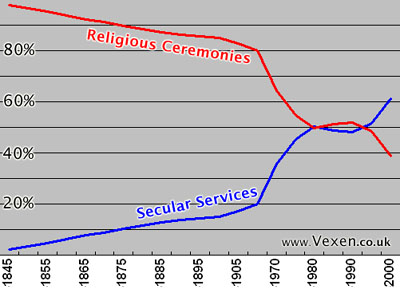
Percent Marriages in the UK51
Marriage is at its lowest rate in the UK since records began in 186252. The history of marriage rates suggests that secular marriages are showing strong growth, whereas other Christian weddings have been decreasing in number for over 150 years. This prehistory was changed in the period since the 1960s, when the decline of the religious institution in the UK went into full swing.
“Between 1993 and 2003, the number of Jewish weddings in England and Wales slipped by 17%, while Anglican weddings fell by 37% and Catholic unions tumbled by 44%”
"Kosher in the Country" in The Economist (2006)53
| Total Marriages, UK | |
|---|---|
| 1971-1975: | 1,996,422 |
| 1976-1980: | 1,822,654 |
| 1981-1985: | 1,734,048 |
| 1986-1990: | 1,726,024 |
| 1991-1995: | 1,491,598 |
| 1996-2000: | 1,350,290 |
The rise in secular marriages from the teens in the 19th century, to 20-something percent in 1900-1930, was not met by a rise in divorces, as many Christians at the time bemoaned would happen. However, as we will see below, social changes have led to massive increases in divorce rates (above all, amongst Christians) since the late 1960s (ignoring the World War 2 aftermath). The overall marriage rate has decreased over the same period; indicating again that society has moved away from the traditional idea of what marriage is.
Europe in general has seen similar trends. In 1970 there were almost eight marriages per 1000 people per year, but in 2004 that had steadily dropped to less than five. The average age, like the UK, has also increased across Europe, now being at over 30 for men, and nearly 28 for women.55
8. Divorce Statistics
The legalistic basis of marriage has the advantage of making divorce a little difficult: if a couple go through a difficult patch and it seems hopeless to continue, there is added pressure to carry on because of the effort required to legally end a marriage. If the troubles don't end then the relationship can still end, once the effort is deemed worth it. In cultures with arranged marriages, the pressure to stay together is even stronger, prioritizing stability and family relations over individual troubles. This becomes problematic where forced marriages remove any consent and free will of the couple: attempting to leave a marriage can result in murder in the guide of 'family honour'.
In total therefore, suspiciously low divorce rates are a bad sign for society. But, high divorce rates are a bad sign for stability.
8.1. Changing Society
#bolivia #philippines #spain #USA
Marriage was once a lifelong certainty, like a job or one's nationality57. But, all modern things change quickly and are more temporary. Jobs, like marriage, are no longer assumed to be life-long bedrocks of stability in the West. In 'collectivist' or community-orientated countries where marriage is pragmatic rather than romantic, marriages last much longer.
“Divorce rates vary widely by country, ranging from .01 percent of the population annually in Bolivia, the Philippines, and Spain to 4.7 percent in the world's most divorce-prone country, the United States. To predict a culture's divorce rates, it helps to know its values (Triandis, 1994). Individualistic cultures (where love is a feeling and people ask, "What does my heart say?") have more divorce than do communal cultures (where love entails obligation and people ask, "What will other people say?")”
"Social Psychology" by David Myers (1999)58
Although the chart shows a massive increase in the divorce rate over a long period, it has since then dropped off. Fewer people are marrying, but, divorces have now dropped to their lowest level since 1981, at a rate of 11.9 divorcing people per 1,000 of the married population59.
8.2. Demographics of Divorce
Various factors are correlated with a higher chance of divorce: religion, poverty, and poor education. It's not clear how any chains of cause-and-effect might work (if any). There are some communities, especially amongst the very poor and those with disrupted lives, where there are not many long-term, stable, marriages.
“Having never observed a stable marriage close-up, she will have to guess how to make one work. By contrast [a girl from a stable family] has never seen a divorce in her family. This makes it much more likely that, when the time is right, she will get married and stay that way.”
"Marriage in America" in The Economist (2007)49
Christians have a higher divorce rate, and as Christian beliefs pass away in the UK, divorce rates have dropped significantly.
Immigrants tend to have a more conservative attitude towards marriage and divorce less often52; as the UK's populace ages, immigrants make up a higher proportion of marrying-age adults who are more likely to stay together.
People who marry are marrying older52 after a period of cohabitation, meaning that marriages last longer.
