General Neophobia in Everyday Life
Humankind's Fear of Progress and Change
https://www.humantruth.info/neophobia.html
By Vexen Crabtree 2009
Mankind is afflicted with a psychological weakness: we fear change. Neophobia in its psychological context is the pressing fear of things that are new, including changes in routine and "new" foods. Societally it explains why ideas, inventions, fashions, morals and other societal changes are often resisted despite their logical advantages.1,2. Many negative reactions are amusing in retrospect. Examples include the widespread outcries against centralized timekeeping, against soldiers wearing camouflaged clothes and against daily news - it would stir everyone into perpetual panic and destroy society3. Moralist Gerald Heard in 1937 warned that mechanistic physics, particularly that of Newton, held the blame for undermining mass ethics4.
Neophobia is easy to see in retrospect, but it is harder to see where it might be having an effect on us right now. In an age where we choose to indulge in risky behaviours such as luxury food, sports, drugs, drink and smoking, it makes no sense for us to shun GM food which undergoes extensive testing. Hollywood continually produces horrors and science fiction dramas based around technology-gone-wrong - I don't think there's a single film where mass produced Artificially Intelligent robots save the day. Proclamations that some new technology will destroy the fabric of society continue: what all these predictions have in common with those of the past is that they have all been wrong.
- Medical Neophobia
- The Causes of Neophobia
- Neophobic Reactions
- Modern Emanations of Neophobia
- Spotting and Preventing Neophobia
- Links
1. Medical Neophobia
In medical and psychiatric terminology, "neophobia" is mostly associated with an aversion to new foods that is severe enough to have dietary implications. It is associated with autism, where daily routines can be followed compulsively and any change causes extreme discomfort. As a medical condition it involves a dysfunctional panic-reaction to new things. This page is not about the medical disorder, but about neophobia as a general trend in society.
2. The Causes of Neophobia
2.1. The Status Quo Bias: The Fear of Change is Greater Than the Fear of Known Risks
People are biased towards things as they are now, and are biased in general against changes. All the advances of the 19th century - the political stability of the nation-state, national police forces, enlightenment, mass education, social regulation and law, economic organisation, industrialisation, modernity, individual rights (i.e., legal contracts and law), were all battled bitterly against by the majority of the ignorant, ill-educated masses5, mostly for reasons that today we understand as being emotional rather logical. This bias manifests itself in many subtle ways and people construct excuses and reasons in order to support their 'gut feeling' against a change. Such reasons are intellectualisations of an intrinsic feeling. This is called the status quo bias by cognitive psychologists and social theorists.
En masse, populations continue over-eating, smoking and taking illegal drugs despite the seriousness of the known risks. The first two items in this list are the two biggest causes of mortality apart from heart attacks (in some countries). Changes in lifestyle choices can prevent over half of all cancers6. These risks are ignored because the behaviour is normal and common. But with new technologies even where the risks are known to be tiny, undetectable or unreal, people cite 'unknown risks' as the reason for their repulsion. Mountains of evidence point to smoking as a cause of cancer, and there is no evidence that mobile phone usage causes cancer. But which do people fear most? People tend to ignore good scientific advice about old vices they already indulge in, yet fear new technology. This is neophobia.
2.2. Current Events Ego
#current_events #ego #media #psychology #sociology #thinking_errors #UK
There are other causes of neophobia aside from the status quo bias. It always seems that today's battles are highly significant; as a result, any area where we can find fault is an area that must be debated hotly.
“
“Nothing in life is as important as you think it is when you are thinking about it.”
"Thinking, Fast and Slow"
Daniel Kahneman (2011)7People mostly think that the times in which they live are more important than any other time. People have been doing this for quite some time. The first century Jewish historian Josephus bemoaned this aspect of Human nature two thousand years ago8 and since then our egos show no sign of letting us be more objective. Our egos make current events in the world around us seem more significant and cataclysmic than at any time in history. The scientist Lawrence Krauss9 states that "we are hardwired to think that everything that happens to us is significant and meaningful"10. We are, after all, at the centre of our own little universes.
“Remember that people take more interest in their own affairs than in anything else which you can name.”
"Routledges Manual of Etiquette"
George Routledge (1860)11Academics fall foul of this as much, and probably even more, than the layperson. For example, the sociologist Peter B. Clarke says that "the present age might well be described as an axial age" due to the scope and importance of changes in the current era12. Four sociologists from the Open University staff describe the "contemporary UK" as "a society which appears to almost everyone who lives in it to be in the throes of change"13.
I have never read a historian or social commentator say that they are living through times which are routine. Those who lived through the industrial revolution reported that Humanity was going through its most significant and disastrous change. But now, it is history. It is nothing compared to the telecommunications revolution of the present. Changes which are affecting us in our living lives seem much more important to us than the changes of the past. Once change has passed we no longer experience its importance. It becomes abstract. Changes that affect our own lives are made by our hungry egos into things that must be important for everyone. But future generations will wonder why on Earth we were all so hot under the collar: they will know that their generation lives in the most precarious and important of human times.”
2.3. Religion's Role in Neophobia
We have already mentioned above that the status-quo bias and small-thinking on a local scale rather than a global one, are both elements of traditionalism. Religion has long been a champion of traditional ways of acting and thinking, and it is often religious institutions that are the last to accept change. This has proven true in matters concerning the ending of slavery, the ending of discrimination against homosexuals, gender equality and the adoption of new scientific theories (like the fact that the planets orbit the sun, the big bang theory and evolution). Religions come to codify and ossifize human practices especially when such practices are under threat from progress and change. Religious activists and communities tend to become very entrenched in their positions against progress. In his book on genetics, Prof. Green bemoans the fact that the USA is falling behind in genetics research because of the political clout of the religious:
“At the same time that genomic science and reprogenetic medicine are rapidly advancing, the United States is in an era of biomedical and bioethical retreat. Appealing to the conservative religious base, President George W. Bush has all but shut down aid for reproductive health initiatives around the world and crippled federal support for stem cell research in this country.”
"Babies by Design: The Ethics of Genetic Choice" by Ronald M. Green (2007)14
I have described many of these battles more fully elsewhere:
- "Christianity v. Astronomy: The Earth Orbits the Sun!" by Vexen Crabtree (2017)
- "Religion and Abolition of the Historical Slave Trade" by Vexen Crabtree (2003)
- "The Peacock vs. the Ostrich - Religious Behaviour and Sexuality" by Vexen Crabtree (2008)
- "Religion Versus Womankind" by Vexen Crabtree (2007)
3. Neophobic Reactions
3.1. Reactions Against Youth Culture
It seems to many in the modern era that current elements of youth culture are particularly rotten. Mass stupidity, mass ignorance and intolerance, rising crime rates and youth violence all seem related to violence in modern music and film. Yet you do not have to delve too far back into history to find that every era has had the same concern. Professor Sonia Livingstone is Professor of Social Psychology and Head of the Department of Media and Communications at the London School of Economics, and she says that "every technology generates a huge anxiety that it is rotting children's brains, ruining family life and alienating children from the community. We've heard these claims for every medium there's ever been, from comic books to film and television and mobiles"15.
It seems that there is always something popular amongst the young that elders consider to be too dangerous to allow to accept. There is always some new mass-media technology threatening the fabric of society. Writing, the printing press, illustrated prints and the internet have all been hailed as the end of social humankind, and to be a cause of ignorance. Is this all a simple case of neophobia, of the older amongst us simply rejecting elements of youth culture that happen to be new? I think yes, but, it is also not the whole story, as Professor Ferguson alludes to in an essay on video games and youth violence:
“We'd love it if our children would read more, take an interest in classic Greek plays, or get more into the music that we older folks enjoy. Society's elders repeat the same cycle from generation to generation, becoming suspicious of new art forms that they don't use and have no use for. It appears to be part of human nature to disparage youth culture whenever it emerges, perhaps as a means of maintaining dominance in the guise of "protecting children."”
"Violent Video Games: Dogma, Fear and Pseudoscience"
Christopher J. Ferguson, PhD (2009)1
3.2. Reactions Against Mass Media
In present times, much criticism is aimed at the violence and grimness of rap music, extreme metal music, violent computer games16 and a perceived increase in violent films. Christian concerns are also prominent on things such as Harry Potter, Dungeons & Dragons.17. The Internet is said to be the demise of common knowledge, and people come to use search engines, rather than memorize things18. Such things have been said before about the printing press, and the Victorians seem now to be completely off their rockers when they complained that the speed of the telegraph message would lead us to psychological problems and anxiety3.
A few generations ago, prim and proper Americans were horrified by such evils as rock & roll (complete with references to sex!), fantastical (and violent) comic books, jazz music and black music in general. Jazz music and rock'n'roll destroyed souls and damaged people, apparently.
The printing press, alongside music, plays and games, has received a large share of these types of concerns:
"In one of his last poems, published in 1850, Wordsworth opined that the infantility of illustrated newspapers - the first tentative steps towards the multimedia of today - would drive us back to "caverned life's first rude career" [...] and he felt that the endless influx of news from daily papers would incite us to a level of unbearable restlessness"17.
In the 15th century CE the printing press was said to endanger the ability of humankind to think straight, and retain a working memory. It would destroy general knowledge, they said. Such was the fear of new forms of information flow.18
2,400 years ago similar concerns surrounded the popularization of writing. Concerns were embodied in an Egyptian tale about the god of magic, Thoth, who invented writing. A horrified Earthly king exclaims that it will mean the demise of wisdom and truth as "they will not need to exercise their memories".18
In antiquity, Greek wise men debated the perils of Greek stage plays, thinking that the way violence and drama passed as entertainment would undermine Greek culture1. Nowadays anyone with knowledge of Greek plays is considered a true academic geek, and not deemed likely to have destroyed his own character by exposing himself to them, even though the sex and violence is as central as in modern youth culture.
Many elements of youth entertainment have been sternly denounced by seniors as precipitating a violent demise of society. In all cases, such predictions have been wrong. Shakespeare's plays (like Greek classics) are full of violence, murder, suicide, drink, etc, yet we have accepted that enjoying Shakespeare does not predispose young adults to violence in real life. Perhaps this is because the types of people who are stereotyped as digging the classics are not the types of poverty-stricken children that are stereotyped as being involved in violent crime.
The high-and-mighties of society subconsciously take an approach that is so simplistic it somehow appeals. If the poorer elements of society are into certain types of music or culture, then, it must be that those elements of culture are causing their misbehaviour. Well, jazz, heavy metal, Greek plays and the written word have achieved two things: (1) They failed to cause an outbreak of violence as they became popular, and (2) they generally entered the mainstream. Violent videos games, just like violent plays and violent written works, will follow the same trend. These products should achieve a third thing in addition to the first two: (3) teaching worry-worts that it is rarely popular elements of youth culture that cause rebellious youthful behaviour. The cause of such behaviour is youthfulness.
To curb violence, wiser parental guidance is needed, not a morbid fear of the new culture that is brought into being along with a new generation. To remain intelligent, we need to not disparage the types of things the young are learning, but ask ourselves if our own concerns are still the correct concerns, and that we are not simply fearing what is new in culture.
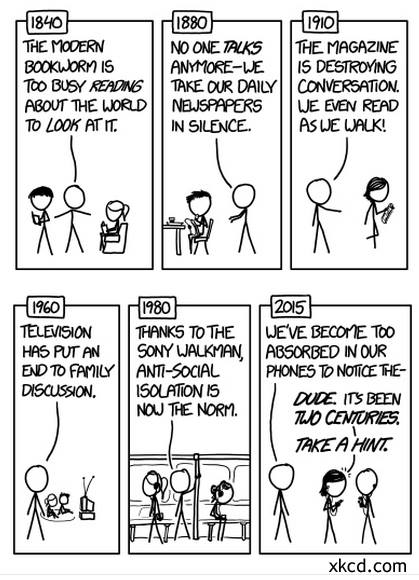
There is a strip from XKCD that I enjoy distributing to demonstrate this point:
3.3. The Role of the Press in Creating Hysteria
#daily_mail #mass_media #newspapers #paranoia #the_sun #uk_newspapers #western_culture
Downmarket media publications reflect - and exaggerate - many of the fears of society. News outlets have dropped most fact-checking and critical analysis steps in order to churn out news more cheaply and quicker and as a result daft and untrue stories are appearing in mainstream news19,20. There are virtually no checks or quality control mechanisms that newspapers have to adhere to, and, occasional outrages against press misbehaviour are quickly forgotten by paying customers. The purpose of it all is (1) sell more newspapers, or (2) influence public opinion. People are all too willing to believe exaggerated claims. People want their lives to be part of historical drama21. The millennium bug, worldwide pandemics, moral panics and fear that society is going wrong all betray humankind's neophobic reactions to progress and change. Newspaper editors pick on this fear and concoct alarmist stories from everyday events and statistics; for example they publish alarmist articles on dangers from mobile phone masts even though there are none, and there are almost no good-news stories about children despite massively improved circumstances22. Many editors and media owners have explained the usefulness of fear-mongering and sensationalism - it certainly sells more copy than balanced news. Fears become amplified and made more real by their appearance in headlines, creating a hysteria about a topic whereas in reality things are much more mundane and acceptable23. Professional broadcaster Fraser McAlpine says "news outlets are behaving like spoof sites, and they're making spoof sites look like sensible news" and people are finding it harder to tell the difference24. Modern newspapers and news outlets are producing low quality, misleading and untrue stories because they are driven by consumers who prefer entertainment, gloom and outrage rather than serious text of reasonable reading. Some news outlets remain high quality, with good fact-checking and little clickbait; but the modern era in which quantity-of-page-views is more important than reputation means that quality appears to be permanently lost from popular outlets. Always remember that after thousands of hyped-up press warnings, on midnight of the 31st of December 1999, nothing happened.25
For more, see:
3.4. Reactions Against Technology: Many Fears Now Look Daft (Luddites!)
Many fears against technological innovations have seemed reasonable at the time but have turned out to be simply daft, such as the fears that the printing press would result in lack of knowledge as people wouldn't need to learn things anymore, and, that access to daily news would cause social hysteria. The science historian Patricia Fara reports that in the 1830s such ridicule was poured on to the futuristic possibilities of steam power that it was widely worried that it would lead to complete moral decadence and intellectual deterioration. Some arguments are clearly artefacts of their time: "After all, if the labouring masses could afford education, travel, and luxuries, then perhaps they would neglect their duties?"26
“In Victorian times, it was anticipated that going through a dark tunnel in a train at high speed (30 mph) would be such a shocking experience that people would come out the other side irreversibly damaged. [...] Railway journeys and tabloid newspapers have not had the dire effects that were predicted.
Prof. Raymond Tallis (2007)17
Every new mass communications technology has fallen foul of neophobia. The same-old fears are repeated about new technology, whereas old-and-familiar technologies are silently accepted.
“Not so long ago television was scary. It was held to turn children into imbeciles, make men violent and corrupt political discourse. Books tried to alert people to the menace in their living rooms: the best of them was Neil Postman's 'Amusing Ourselves to Death', published in 1985.”
The Economist (2010)27
Some warnings are clearly self-interested. Bookworms argue that books are better than Internet encyclopedias, non-photogenic radio voice actors complained of the evils of early obsession with TV moving-picture stars, and traditionalists argue against any social change that ensues from modern inventions. Pannyavoro says that Buddhist leaders have been arguing for some time that the Internet could harm religious development28. It is often forgotten that Communism was founded in the era of industrialisation that saw machinery taking the place of workers in factories throughout the West, which, in an era before health and safety and good workplace governance, often meant that workers were engaged with machinery in unsafe and uncomfortable conditions. The Communist Manifesto, in recent decades, has come to sound like an overly-worked luddite fantasy. It explains that "the proletariat goes through various stages of development", directing "their attacks not against the bourgeois conditions of production, but against the instruments of production themselves; they destroy imported wares that compete with their labour, they smash to pieces machinery, they set factories ablaze, they seek to restore by force the vanished status of the workman of the Middle Ages"29. Highly technologically advanced factories have given mankind a long series of amazing goods which have benefitted all, but which, without a doubt, the average sausage-fingered human being could not possibly construct (be they born of the Middles Ages or not).
Despite the occurrence of occasional bias it is clear that these fears, taken seriously and promulgated at the time by philosophers, psychologists and other seemingly intelligent people, did not take major aspects of human psychology into account: As a species we have survived massive changes in the structure of society. Not only technology-driven changes such as the industrial revolution, but changes such as becoming a species that farms for food rather than scavenges, a species that communicates using abstract language, and moved from goods trading to using abstract national currencies. These massive changes have been absorbed and it is unlikely that any particular technology can now cause such tumultuous change that society itself is in danger. Most these concerns actually translate into: "something that I am used to is changing and I don't like it!".
3.5. Radiation
We saw that in zombie films and other Hollywood products often used the idea of 'radiation', sometimes in a very simplistic manner, to sow the seeds of fear and horror. There exists as part of the fear of the invisible and the unknown, a fear of 'radiation'. This is despite the fact that the colours of the spectrum and radio signals are both forms of radiation, along with infra-red light (all are merely different frequencies on the electro-magnetic spectrum). This general fear of immaterial waves plays a part in the https://www.humantruth.info/radiation.html. Dr Frank Barnaby, a specialist on military technology and nuclear physics, points out that this fear is also a weapon in the hands of terrorists:
“The true impact of a dirty bomb would be the enormous social, psychological and economic disruption [...]. It would cause considerable fear, panic and social disruption, exactly the effects terrorists wish to achieve. The public fear of radiation is very great indeed, some say irrationally so.
The effect is that, in the dirty bomb, terrorists have a particularly dangerous weapon only if the media continue to mislead people into believing it is particularly dangerous.”
"Flat Earth News" by Nick Davies (2008)30
Nick Davies, a journalist and media analyst, warns that as long as the media publish sensationalist articles and news that is not checked for scientific accuracy, such fears will continue to be spread in a self-perpetuating cycle.
3.6. Military and Warfare Issues
3.6.1. Wearing Desert-Coloured Uniforms
To wear green camouflage (greens) in Europe and deserts in the desert is so much common sense that it hardly seems worth saying. But the introduction of camouflaged uniforms, despite all the obvious advantages, was once a hot-topic, with the opposition warning that the demise of the British Empire was imminent if we stopped wearing red uniforms. Once again, neophobia provides excuses and emotions that are way out of sync with the practical ideas being proffered by reformers, developers, and in this case, military strategicians. Check it out:
“During a series of colonial wars in the nineteenth century, the British Army gradually changed the colour of its soldier's uniforms from the traditional scarlet to khaki [but] the innovation was sharply resisted. Regiments who were still dressed in scarlet sneered at their transformed colleagues, disgustedly calling them 'khakis' (the word was well-known to be a 'native' one, the Urdu term for the colour of dust or mud). [...] The public, too, had a scandalized sense that it was no longer being properly protected. Thus in 1892 a columnist in The Pall Mall Gazette wrote in some alarm, "Khaki [...] tends to promote slovenliness". [...]
Scarlet uniforms were habitual. They were normal. People were used to them. 'Business as usual' always tends to seem more practical, more realistic, than these fanciful new schemes we're not used to. So scarlet was what made the public feel safe.”
Dr Mary Midgley (2007)31
'Feeling safe' rather than thinking safe is the warm-cuddly feeling of the known good, the status quo. It blinds people to the disadvantages of the present and even the surest improvements are resisted on account of them being new. Such deplorable Human behaviour is easy to spot in retrospect but it is very difficult to prove where neophobia is active today. In the context of defense, let us discuss one topic that certainly seems to fit the bill:
3.6.2. Combined European Defence
"Uniforce: An International Military Force" by Vexen Crabtree (2008)
Despite the advantages of pooled military defence, there is much public concern about things such as combined European defence, even though the advantages far outweigh the theoretical disadvantages. Because it is big, and new, there is much opposition to it even though the status-quos in international defence are widely acknowledged to be broken. One political and military theorist light-heartedly compares this to the Brits' fear of the Germans winning the World Cup:
“It is a truth universally acknowledged, at least in Great Britain, that there is no chimera more appalling than the notion of a European Defence. Possibly the only thing more disturbing to a British sensibility is the - it is hoped, only marginally more likely - spectre of the Germans winning the World Cup. True, the European Union's present efforts at establishing a Common Security and Defence Policy leave much to be desired.”
Constanze Stelzenmuller (2006)32
Media coverage of the ESDP (common European defence policy) has been entirely negative, despite the commendation of senior military experts and diplomats in Europe. In the future, when a European or International military force exists, historians will look back and puzzle over what our problems were with its creation, just like we puzzle over why townspeople were so against the creation of standard national time ('railway time'), enshrined into law in 1880.
3.7. Timekeeping
3.7.1. Greenwich Mean Time
“Until the mid-nineteenth century, towns operated on their own local time, and residents set their clocks by the stars and the Sun. When trains started linking places hundreds of miles apart, it became essential to coordinate clocks throughout the network. In Britain, the railway companies agreed to use London time, measured from the stars every day at Greenwich and flashed out all over the country by telegraph signals along the tracks.”
"Science: A Four Thousand Year History" by Patricia Fara (2009)33
Once many changes are made it can be hard to imagine what our original problem was with it. Where the advantages of progress speak for themselves, it is only time that we needed in order to become accustomed to them. For example, take the creation of a standard time which was clearly required so that everyone agreed on things like when meetings were and when trains ran. People opposed this move on the ground that it removed power from locals. Small thinking and the status quo bias are both elements of traditionalism, where people simply oppose change because they consider the old ways 'traditional' and therefore better than what is new.
“By 1894, Greenwich had acquired a peculiar significance: it not only marked 0° longitude, it also stood for the standardization of time. For much of the nineteenth century, different towns in Britain kept their own time, and travellers from one place to another would often have to reset their portable timepieces on alighting. But the development of the railways made it increasingly important to dispose of these local variations, and 1952 saw the introduction of a standard 'Railway Time', as it was called. Finally, in 1880, Parliament passed the Definition of Time Act, which introduced a universal time, this being defined by the time on the Observatory clock at Greenwich. This, as we might imagine, could well have induced in some quarters the same resentment as the idea of a single European currency does in others today.”
"Travels in Four Dimensions: The Enigmas of Space and Time" by Robin Le Poidevin (2003)34
The centralisation of timekeeping led to riots; clocktowers were burned down and governors assaulted. It is hard to imagine what the problem was, but, that is because we are so accustomed to the advantages, and tradition has given way to practicality.
3.7.2. Sultan Murad III (1561)
“In the East clock time was [also] controversial. Sultan Murad III, like his ancestor Mehmed the Conqueror, was curious about Western mechanical clocks. [...] In 1561, he made a clock that showed the times of prayer, an instrument destroyed because it was considered to be an infidel device seeking to replace the muezzin and the power of the human voice.”
"Infidels: A History of the Conflict Between Christendom and Islam"
Andrew Wheatcroft (2004)35
Neophobia can arise from defensiveness against secularisation - the religious call to prayer was deemed to be a religious source of authority, and couldn't be replaced by a mechanical one!
And to highlight the pressing need for a simple, national time - or rather, an international one, Wheatcroft also mentions that some watches had multiple times on them - i.e., a Turkish one bought just a few generations ago still had mosque time (hijri), government and business time (mali) and Western time (alafranga).
3.7.3. A Base 10 Method of Timekeeping?
Another area of time-keeping deserves a mention.
We all know we divide time into 60 seconds, 60 minutes, 24 hours, 7 days, 4 weeks and 12 months. But in antiquity there have been many ways of recording the passage of time, and many ways to divide up the year into seasons and months. Although the Egyptians may have first divided the day into 24 hours over 5500 years ago36, it was the Babylonians in their star-gazing, moon-charting enthusiasm who divided time into divisions based on the movements of the moon and sun. They divided weeks into 7 days to correspond to phases of the moon, and hours and minutes into divisions of 60 because they had a base-60 numbering system37, and gave us the Zodiac.38. Moon-based and sun-based system became the foundation of Jewish and Christian calendars, and has remained in place as the world's most common system of time-telling. In Qur'an 9:36 it even says that God itself, not us humans, ordained the division of the year into 12 months.
Base-60 calculations are far from practical and introduce many complications37. Calculating the number of days inbetween two dates is a horrendously multifaceted affair. We have moved on. Numbering systems are base-10 almost everywhere. Our recording of time should also change; such a change would have advantages in man-management, physics, programming, engineering, etc, where we'd no longer need to mix numbers from base-60 and base-10 numbering systems.
A system of base-10 temporal measurements was introduced during the French Revolution with 10 hours in a day, and 10 days in a week, but it was abandoned in the face of almost universal terror at the thought of changing our cherished (but odd) system of dividing time37. An example will highlight the issue: If a strut is sinking at the rate of 1mm per second, how far does it sink in a day? With our current Babylonian system, the calculation is horrendous. In a base-10 system, it would be easy: something like 10 seconds per minute, times 10 minutes per hour, times 10 hours per day is 1000mm. Unfortunately, such a rational move is not on the horizon, and the mere thought of it fills people with dread. This is only a footnote though, because I imagine much of the dread comes from the quantity of hard work required to recalibrate and reprogram pretty much everything modern, rather than from genuine neophobia.
3.8. Vaccines and Inoculations
#france #health #medicine #neophobia #vaccines
Vaccinations have saved millions of lives and prevented an uncountable number of long-term debilitating disabilities that result from disease. In the developed world and elsewhere many serious diseases have been eradicated (or almost eradicated) through vaccines.
“Only two generations ago we had schoolmates who limped or had withered arms due to the paralytic polio they were infected with. That disease is now extinct in the U.S. because of the universal use of polio vaccine. During my training, I cared for children made deaf from measles, infants blind and retarded from rubella, and those who died from bacteria like pneumococcus and meningococcus. With vaccination, those conditions no longer occur.”
"Vaccine Safety: Vaccines Are One of Public Health's Great Accomplishments"
Richard G. Judelsohn, Dr (2007)39
It all began with smallpox:
“In the 1790s, the country surgeon Edward Jenner took the sensible step of listening to local farmers and dairy-maids, who maintained that after people had recovered from cowpox, they rarely succumbed to smallpox. [... He] invented the smallpox vaccination.”
"Science: A Four Thousand Year History" by Patricia Fara (2009)40
From the outset of inoculation and vaccination, fearmongers put many inaccurate and dramatic comments in newspapers warning people against the adoption of this new disease prevention technique.
“There was a strong anti-smallpox-vaccine movement in Leicester well into the 1930s, despite its demonstrable benefits, and in fact anti-inoculation sentiment goes right back to its origins: when James Jurin studied inoculation against smallpox (finding that it was associated with a lower death rate than the natural disease), his newfangled numbers and statistical ideas were treated with enormous suspicion. Indeed, smallpox inoculation remained illegal in France until 1769.”
"Bad Science" by Ben Goldacre (2008)41
One satirical cartoon of the 1790s/early-1800s reflects the more ridiculous fears of the time:
“A woman on the right is simultaneously vomiting and giving birth to cows, while several patients have grown cow-shaped excrescences. [...] Protests against vaccination continued right through the nineteenth century, long after its efficacy had been demonstrated. [...] Although vaccination did appear to work, powerful campaigners - including Florence Nightingale - protested that the state had no right to interfere in people's lives by making vaccination compulsory. This opposition to government control meant that smallpox epidemics continued to break out in Britain even in the twentieth century.”
"Science: A Four Thousand Year History" by Patricia Fara (2009)40
Thankfully the benefits of immunisation were so dramatic and immediate that as their usage spread, opposition was washed away, excepting some "religious communities, where vaccine uptake has been historically low"42 and a few other minor, extremist or secluded communities. Hence, we arrived in the modern world with genuine hope that many horrible diseases could be wiped out globally, forever.
For more, see:
- "Immunizations: International Statistics on Vaccines and the Autism Scare" by Vexen Crabtree (2017).
4. Modern Emanations of Neophobia43
4.1. In What Ways are We Repeating the Same Mistakes, Right Now?43
#artificial_intelligence #futurism #neophobia #robots
We would be fools to think that all of these daft and irrational fears that have afflicted mankind in previous generations, have for some reason ceased to affect the current one. There are things, right now, which many people are scared of, resist, and inveigh against. And in just one generation or two, the developed world will look back at us and think... "idiots!" in just the same way we think about those who worried that the availability of news of TV would turn us all into such quivering wrecks that no-one would be able to continue living normal lives.
A General Fear of Genetics (see text, below). The furore against stem-cell research, genetically modified foods, gene-screening and other related areas of research and technology embodies one of the modern world's most paranoid outbreaks of neophobia. All of these endeavours will be beneficial, and some of them, unimaginably beneficial, with the same scope of impact as the Internet has had. Once these technologies are more widely accepted, it will be hard to imagine how we ever done without them.
Wind Farms. This is a favourite hate of the NIMBYs - which are those who do endorse good, green and beneficial developments in general, but "Not In My Back Yard". Whilst NIMBYism isn't neophobia, note that it is new developments that are resisted: Very few and far between are those who object to roads, power lines and telegraph poles.
Changes in the English Language. Although there are good arguments as to why we have to maintain stability and discipline in the use of language, and therefore, it is true that not all change is good, many of the specific complaints about English do have an air or neophobia about them, for example the outcries of some against the use of SMS-speak (including myself, I am afraid to admit) are generally a little unfair given that English was not designed to be rapidly typed in real-time across the Internet or into little boxes on websites, or little screens on mobile phones. A change in circumstances appears to be a strong motivator towards a change in language usage. To resist it is probably as futile as it is facile.
It is also ironic. The once-strong-and-vocal campaign for spelling reform included some sensible things as turning the monstrous placename "Gloucester" into "Gloster" and correcting many other inconsistencies of English spelling. But now, people wince if they see the word "mate" turned into "m8". Both areas of change share some unexpectedly similar goals such as increased phonetic spelling and brevity and a better ease of use. There are two differences between the first reform movement and the second: the first is comprised of highly educated people, but, will probably be a failure, and the second movement is comprised of mobile-phone-wielding teenagers, and appears to be unstoppable.
The Internet. The latest online trend, whether it is a new range of social media websites, new games, some particular insanely popular content, or daft new trends, two things will certainly occur: firstly, many will complain about the deleterious effect that it will have on family relations, personal lives, mass morality and the ability for any of us to think straight and learn stuff. And secondly, in a few years, all of those complaints will be forgotten and society will still be intact.
“These days newspapers are filled with tales of Facebook stalkers, Craigslist killers, cyber-bullying, sexting and screen addiction. E-mail, blogs and YouTube, not television, are held responsible for the degradation of politics.”
The Economist (2010)27
“We wonder whether social networking might be fuelling political revolution. And we ask if Google is making us stupid - or at any rate whether networked technology is reducing attention spans, devaluing memory and blurring the line between making online connections and forming real relationships.”
Naughton (2011), quoted in
"Media Studies: The Basics" by Julian McDougall (2012)44Poor judgement is apparent even amongst the Internet-literate, just in the same way that criticism of new mass media outlets becomes criticized by established and well-educated sociologists (we've quoted from many of them in this text, already!). One current worry is "information overload": A massive excess of online content, online choice, and instant access to immeasurable volumes of information much of which is relevant to whatever task we have at hand - leads to a paralysis in our ability to make sensible and timely decisions, because we are all too aware of how much data we haven't yet looked at.
“Commentators have coined a profusion of phrases to describe the anxiety and anomie caused by too much information: 'data asphyxiation' (William van Winkle), 'data smog' (David Shenk), 'information fatigue syndrome' (David Lewis), 'cognitive overload' (Eric Schmidt) and 'time famine' (Leslie Perlow).”
The Economist (2011)3
Artificial Intelligence:
“Predicting the future is not easy. Neither the Internet nor mobile phones were particularly foreseen by previous generations. All extreme predictions of cataclysm (from overpopulation to technological doom) have failed to come to pass. The only types of prediction that come true are those that are vague, or those which predict the downfall of various cities or nations - which if you wait long enough, always comes true. Since the 1980s there have been an inexhaustible supply of dramatic films in which robots become self-aware and attempt to wipe out humanity (i.e. The Terminator (1985), The Matrix (1999), I, Robot (2004)). The first to take up this theme was the 1920 play R.U.R. (Rossum's Universal Robots) by Karel Capek, where robot slaves rebel against mistreatment and destroy the human race45.”
4.2. A General Fear of Genetics (Hollywood Hasn't Been Kind)
 Many new-science fears center on genetics. Horror films since the dawn of the b-movie have populated Western imaginations with stories of scientific experiments gone wrong, resulting in everything from monstrous chimeras such as Frankenstein" and The Fly, to virus films such as 28 Days Later and I am Legend that see our geneticists accidentally turning everyone into mutated, murderous animals. Others such as Gattaca show us that in a world where genetic engineering exists, many elitists will consider themselves better than others. It is possible to find films that portray genetic engineering in a positive light. None come to mind, but, I saw at least one mentioned in an article once. The film didn't sound as exciting as Outbreak, The Twelve Monkeys or Stephen King's The Stand, which all include deadly engineered viruses threatening to kill everyone with horribly nasty colds. In the latter two of those films, nearly everyone dies. With the Incredible Hulk the engineers produce mixed results, but it is hardly the kind of engineering you would want offered at every hospital. Does this reflect humankind's healthy fascination with the advantages of new technology? I think not.
DNA researchers wish to compile comparisons of different human populations in order to trace our migratory history across the planet. Geneticists need more samples from indigenous populations. There is resistance from such people, they called one scheme a "Vampire Project" and some were worried that the samples would be used to create commercial drugs, which they consider to be "biopiracy"46. Such paranoid behaviour has stopped some research. It is hard to argue rationally against those who don't understand the basics of genetics especially when they do not wish to learn.
We can detect that same type of neophobia in countries where certain genetics industries and research methods are banned in their entirety, for example, some countries ban the importing of GM food, or stem-cell research. No-one thinks that individual human cells are alive and have rights (germ cells are just individual cells), yet the mass media have given the words 'stem cell research' such a bad press and religious activists have (obscurely) taken such a dislike to the concept that they have had a political effect, and managed to hinder and stop progress in an areas of research that they don't even understand the basics of.
4.3. Genetically Modified Food
My text on GM food talks not only about genetically altered food but also about the possibilities of growing meat in vats, rather than relying on animals. Pollsters have found that this idea has been met with general repulsion amongst the general populace. GM rice and potatoes are already commonplace and provide disease-resistant plants in larger quantities than is possible with natural rice. The safety of GM food has been studied extensively on massive scales. We have done much less testing on normal foods! Yet people fear what is new, more than they care to fear the unknown (or known) risks of what is accepted.
“The public furore about health hazards of genetically modified foods rests on no reliable evidence base and falls little short of mass hysteria.”
Sir Peter Lachman (2005)47
“People claim to be risk-averse when it comes to highly-tested synthetically grown meat, and genetically modified plant produce, which is known to be safe, but, continue to eat foods that are known to have bad risks. Cancer Research UK reports that "experts think that about a quarter of all cancer deaths are caused by unhealthy diets and obesity". It is not, therefore, that people mind the risks of meat grown in vats, but, that they don't like new foods. Therefore the opposition to synthetically grown meat is at least partially (or greatly, given the difference between normal risk-taking and GM risk-taking) a result of neophobia. The best course of action against neophobia is simply to slowly introduce the new foods, and let people get used to them over a generation or two.
Another hint that something psychological is going on is the correlation between those in the Eurobarometer poll who said that Humans have a duty to protect nature, and those who think that we should grow synthetic meats so that we no longer have to slaughter (or keep) farm animals. There isn't a correlation between the two groups. Those who want to protect nature, and animal-rights activists, are largely against the growing of synthetic-natural meats. It would make sense that in order to protect nature, end farm captivity (even if not completely), and end animal slaughter, we should grow food that surpasses the need for those things. The fact that those people are against vat meat must mean that there are additional, psychological components to their opposition. You would think that, given the massive alterations to natural species we have engineered in cattle, and the painful and distorted lives that they lead as a result, would mean that we would wish to change the status quo in food production. Neophobia beats rationalism.”
5. Spotting and Preventing Neophobia
5.1. Bostrom and Ord's Reversal Test
There is a test that can be employed to ascertain areas where neophobia was (and is) prevalent: Bostrom and Ord's reversal test. If we fear changes in the future and say that they should not obtain, then, we should look at what advances have already been made. For example in the last 100 years, life expectancy in the West has improved by a dozen years, and so has average IQ. We find no problem with cosmetic surgery to improve looks (it is a profitable industry), for example, even while people say that modifying genes to improve looks would cause an unfair divide between haves and have-nots.
“Status quo bias permeates much of the thinking about genetic technologies. [...] The current life span is perfectly acceptable, whereas age extension raises frightening possibilities. The present range of human IQs is fine, but improvements look dangerous. [...] In each of these cases, the reversal test forces us to ask such questions as "Would it be better if we reduced average human IQ today across the board by fifteen points?" and "Would it be better if we banned reconstructive surgery for cleft palate, or cosmetic rhinoplasty for people who are troubled by their noses?" If the answer to these questions is no, we have to ask why we find the status quo satisfactory but modest improvements so worrisome.”
"Babies by Design: The Ethics of Genetic Choice" by Ronald M. Green (2007)48
It takes a few moments of thought to see how the Reversal Test applies, but if only it was taught at school in some kind of common-sense class, we would see that entire populations come to see their subconscious neophobic reactions for what they are. So, to test: Think of a current advance and imagine reversing it. Should we degrade food production so that we produce less food with more vulnerability to disease? Should we end cosmetic surgery or sports skill that is due to expensive advanced technology? If not, then why do we oppose further advances in these fields? Another test: If we oppose something new due to unknown risks, then, should we give up all other known risky behaviour, such as those of sports? The reversal test reveals if the "risk averse" argument or other arguments are the true forces behind opposition to various advances that affect society.
5.2. The Scientific Method
Opposition to new ideas is a natural human weakness. The intellectual methods that are best employed to reduce the effects of human error on thought are those associated with science. All ideas and theories are debated in science, so that everything is challenged by new evidence or ideas. But many new ideas are wrong, so new theories are also challenged. When it works it is good although you also get neophobic reactions amongst scientists (who are humans, after all). The scientific method, which is concentration on rationality, often allows logic to trump psychological dislike of new ideas. The skeptical thinker and mathematician Martin Gardner has explored what is, and isn't, science, and gives some examples:
“Einstein's work on relativity is the outstanding example. Although it met with considerable opposition at first, it was the whole an intelligent opposition. [... but] history contains many sad examples of novel scientific views which did not receive an unbiased hearing, and which later proved to be true. The pseudo-scientist never tires reminding readers of these cases. The opposition of traditional psychology to the study of hypnotic phenomena (accentuated by the fact that Mesmer was both a crank and a charlatan) is an outstanding instance. In the field of medicine, the germ theory of Pasteur, the use of anesthetics, and Dr. Semmelweiss' insistence that doctors sterilize their hands before attending childbirth are other well known examples of theories which met with strong professional prejudice.”
"Fads & Fallacies in the Name of Science" by Martin Gardner (1957)49
