The False and Conflicting Experiences of Mankind
How Other Peoples' Experience Contradict Our Own Beliefs
https://www.humantruth.info/experience.html
By Vexen Crabtree 2008
- Introduction
- Conflicting Experiences
- Subjectivism: We All See and Experience Things Differently
- Cultural Beliefs and Expectations Inform Experiences
- The Cognitive and Physiological Causes of Strange Experiences
- Explaining Our Experiences
- Shamanism: Altered Consciousness and the Afterlife
- Abstract Man
- Concluding: Errors in Thinking, and Preventative Steps
- Links
1. Introduction
#beliefs #consensus #conspiracy_theorists #delusion #epistemology #expectations #experiences #god #illusion #psychosis #religion #subjectivism #supernatural
There are many neurological and physiological causes of odd experiences in our lives. These range from ordinary tricks of the eye1 through to repeated minor epileptic fits that cause nothing more than visual (or aural) hallucinations combined with emotional cues. Many supernatural experiences can be artificially induced through neural electro-stimulation, proving their mundane basis2. Strange and unusual experiences often give rise to strange and unusual beliefs3,4 especially for those people are not inclined towards finding natural explanations for events. Experiments have found that a person's "psychological tendencies may also be used to predict exact types of 'unexplained' phenomena in which they are likely to believe" and that those who display signs of dissociation are likely to see "a given stimulus item as a paranormal creature, whether Bigfoot or an alien"5.
For example during night terrors, our brain is still suppressing bodily movement and it feels we're being forced down on to the bed, complete with much anxiety and fear. Some people have such attacks multiple times. The belief that this is a demonic attack seems natural to many and even after explaining the physiological and natural causes of night terrors, many continue to believe in a supernatural source. Of course, this is ridiculed by those who know that such attacks are really alien investigations of the Human body. Both explanations are foiled however by neuroscientists who understand that the cause of these experiences is biochemical in nature.
Cultural expectations play a large part in the interpretation of personal events, meaning that the resultant beliefs vary according to geographical region. We all find rational arguments to explain away those who experience things that contradict our own interpretation of reality - in secret, when we find people who have experienced things that we don't believe in, we all think we can explain others' experiences better than they themselves can explain them. Investigations into the physiological causes of strange beliefs comes from an ancient line of skepticism. In "The Supernatural?" by Lionel A. Weatherley (1891)6 the author intelligently outlines many such investigations - and that was well before modern neurology started making its amazing strides towards understanding the sources of experiences. Despite this knowledge, the masses remain generally unconvinced, and stick to ages-old cultural and subjective beliefs. The Christian Pentecostals have a saying, "the man with an experience is never at the mercy of the man with a doctrine"7, meaning that rationality subverts itself to experience. In total, we cannot entirely trust our experiences nor those of others, and more careful investigation is needed by all.
2. Conflicting Experiences
#experiences #skepticism #subjectivism
- God in many forms.
- Resurrection and previous life experiences.
- UFOs and abduction experiences.
- Ghosts.
- Magic and curses.
- Conspiracy theorists.
 All of these 'unlikely' phenomenon have extreme believers who have experienced personal and real events that confirm or caused their belief. It is not possible to tell them, most the time, that these things are not true because no matter how much logic or argument you give, you cannot negate the experiences they have had. Some of the believers are clearly psychotic and are dealt with by psychiatrists in due course however the majority of believers and experiencers of the above items are normal people. And it feels like psychosis to deny what you know is real: Therefore the experiencers of these events cannot dis-believe them unless they see a clear mechanism by which their minds have been tricked8. R. D. Laing, a psychologist, produced influential and genre-setting work with such books as "Self and Others8".
Depending on what you believe, you will make different conclusions about the nature of what other people believe. Those who experiences Gods, Spirits and Demons will say that UFOs are demons. Those that experience UFOs however, will say that Gods are intelligent aliens who have appeared like Gods to us through their power. "Any science, sufficiently advanced, seems like magic"9.
What the contradictory believers are saying to each other is: We believe that we have a better understanding of your experience than you do. Or rather, like all people: We are not capable of not believing in our own experiences, and since your experiences are different we think your experiences are not true ones! We think we are interpreting the things you've seen more objectively than you...
Clearly the range of Human experience gives rise to many contradictions. Not all experiences can be entirely true. We know that the evident facts are sometimes not quite so factual. We have all experienced things that actually did not happen. We have dreamt, tripped, imagined and forgotten things leading us to conclusions and sternly felt beliefs in things that are not real.
We experienced the world as flat... so sure everyone was of this, that those who thought otherwise were at first declared insane. How sure we were of such a belief that we could declare other people insane for disbelieving... yet how wrong everyone was! Proof by consensus is no proof at all. We do not have any consistent or absolute way of approaching what we consider true, however we are more capable of telling with certainty when something is false. The Earth is not flat, the Northern Lights are not spiritual in basis, neither are rainbows, the stars or the sun and the moon. Earthquakes are not gods moving underneath the Earth, nor can volcanoes or the weather (probably) be influenced by spirit or totem worship. We are not sure if science has "disproved" souls or gods, but it certainly seem less likely that they exist than they used to.
Many Christians very much doubt peoples' experiences of reincarnation. The previous lives that are felt and experienced are similar to the modes of experience of the Christian God: it is something that they can be completely sure about due to personal experience. Claims are made that as the belief has occurred for thousands of years so it must be a true and valid experience. But any grounds that the Christian gives for discounting the experience of continual reincarnation is also grounds for dismissing the experience of God. Indeed, any grounds for dismissing the experience of alien abduction (which can sometimes have a profound effect on a persons' life) is also grounds for dismissing the experience of God. In short, we are saying: Your experience is fake. Social psychologists, anthropologists, skeptical rationalists and scientists may well disbelieve all of them, pointing to psychology as the true cause.
It is not doubted that people do have fake experiences. Insane asylums are full of people who experience a different reality to us. We judge them as insane because we know that what they say they experience is not true. We understand that some people's stern and life-altering belief in conspiracy theories are actually based on error.
3. Subjectivism: We All See and Experience Things Differently
#epistemology #perception #philosophy #solipsism #subjectivism
Subjectivism is a problem of epistemology (theory of knowledge). The word describes the fact that we can only understand the world through our own senses and our own rational deliberations, in conjunction with our own limited experience in life. Our brains are imperfect organic machines, not a mystical repository of truth. Our senses are imperfect, our point of view limited, and the reality we experience is never the total picture. Our divergent contexts result in each of us interpreting, understanding and perceiving the world differently to one another even when looking at the same stimulus. Human thought is infused with systematic thinking errors. Our knowledge of absolute reality is hampered by our limited insights and imperfect brains, and we can never truly escape from the shackles of our own minds. Our total take on reality is a mix of guesses and patchwork. These problems have been debated by the most ancient philosophers, thousands of years ago, and no practical answers have yet been forthcoming.10.
Everyone experiences a different reality and there is no way to reconcile the experiences of two different people. Our internal worlds are unverified. No knowledge is absolute. To accept this doubt behind every theory and fact is the scientific way - evidence and logic must back up theories, but theories are never irrefutably proven, they always remain not-yet-disproven. The psychologist William James wrote that many interpretations of reality are arrived at because people find them nicer or better for themselves:
“The obvious outcome of our total experience is that the world can be handled according to many systems of ideas, and is so handled by different men, and will each time give some characteristic kind of profit, for which he cares, to the handler, while at the same time some other kind of profit has to be omitted or postponed.”
"The Varieties of Religious Experience"
William James (1902)11
The result of all this fog is subjectivism, the realisation that our realities as we experience them are completely tied up with personal experience and personal mental traits. Any attempts to learn "absolute" truths will fail, simply because our Human brains are not equipped to deal with reality in an objective way.
For more, see:
4. Cultural Beliefs and Expectations Inform Experiences
Anthropologists find that the particular phenomenon experienced by people change over time and from culture to culture. With UFOology, different decades and countries have sighted completely different UFOs. A period of time in the UK saw that UFO reportings were generally furry/fuzzy aliens. Modern UFO reports are "grays", thin child-like bodies with enlarged eyes and heads. Different countries consistently report different types of aliens, backing up the idea that such experiences are based on subjective interpretations of stimulus, rather than being due to actual visits by aliens. As culture changes, so does the phenomenon. What does that say about the phenomenon? The underlying cause of the phenomenon is something that is being interpreted.
Take the following case involving a bus driver, reported by neurologist Oliver Sachs:
“One of my favorite case histories, which I quote in my book [on hallucinations], is of a bus conductor in London who, as he was punching the tickets, suddenly felt that he was in heaven and told this to all of his passengers. He remained in a very elated state for three days. It sounds as if he was in an almost postictal mania. Then he continued on a more moderate level, deeply religious, until he had another bunch of seizures three years later - and he said that cleared his mind. Now he no longer believes in God and angels, in Christ, in an afterlife, or in heaven. Interestingly, the second conversion to atheism carried the same elated and revelatory quality as the first one to religion.”
Oliver Sachs
Interviewed in Skeptical Inquirer12 (2013 May/Jun)13
It is clear that the bus driver's experience of manic happiness was the result of a neurological event, and it is also clear that his description of the event was due to cultural expectations. A Buddhist would have described a state of Nirvana; an ancient Greek would have described being blessed by the gods, etc. Local culture was the cause of the specific explanation of the experience, and therefore, controlled what the Bus Driver came to believe. Despite such assumptions being the cause, the Bus Driver cited the experience as evidence to back up the belief. The event supported any religion, but actually had a mundane explanation. Against such confusing stimulus, it is easy to see how many come to strongly believe in elements of the supernatural.
Religious experiences tend to conform closely to cultural and religious expectations. Village girls in Portugal have visions of the Virgin Mary - not of the Indian goddess Kali. Native Americans on their vision quest see visions of North American animals not of African ones. Thus it would seem that religious experiences, no matter how intense and all-consuming, are subject to constraint by the cultural and religious norms of the person to whom they occur. Another way of looking at this is to say that there can be no such thing as a pure experience. An experience always happens to a person, and that person already has an interpretive framework through which he or she views the world. Thus, experience and interpretation always combine and interpenetrate.”"The Phenomenon Of Religion: A Thematic Approach" by Moojan Momen (1999)14
Such important differences in interpretation casts doubt on the basis of the experiences themselves, and has been presented (especially in the case of UFOs) as evidence that the phenomenon is self-generated, not real. The experiences are a function of the aspirations and expectations of the experiencer. To the experiencer, all such arguments are meaningless as they have experienced it and it feels "insane" to them to doubt their own experiences. However, doubt them we do, because with so many contradictions between different world-views based on these experiences, we know that many, if not most, of them cannot all be true.
How has the experience of God changed over time? Originally, Gods were more like "spirits", low-scale pre-philosophy beings that inhabited rocks, stones, places, the stars above and the seasons. Scholars call this form of religion animism. These emotional projections were our only method of understanding how these complex things worked. When they behaved strangely, we found that we experienced them as living things! Not surprisingly we found them to have human emotions... at some point psychologists realized that we were just projecting our own inner states on to the world when we claim that beings that are not ourselves share the same emotions. The empathy of an unscientific mind leads to this misunderstanding of the nature of things. A culture steeped in science like modern Western culture, arrives at completely different understandings of spiritual-seeming experience than did primitive Human cultures.
5. The Cognitive and Physiological Causes of Strange Experiences
If our biochemical brains and physiology sometimes go haywire, as indeed they do and we know they do, but we are not aware of a dysfunction, we are apt to misinterpret the events. So, our expectations, culture and abstract thinking all conspire to present to us a false experience. Some medical conditions can cause these to be recurring and frequent occurrences. Through studying these, science has come to understand such experiences as out of body experiences, possession, night time terrors, and through more simple biological knowledge have understood the Inkubus and Sukkubus, and many other superstitious beliefs. Physical problems with the eyes can cause wild effects such as seeing blood run up walls, dust storms, clouds, and haloes that are not really there15. Isolated fits and seizures can cause bizarre effects such as lights, feelings, smells, auras and déjà vu that can be mild and subtle16.
5.1. Hallucinations, Sensory Deprivation and Fasting: The Physiological Causes of Religious and Mystical Experiences
#buddhism #christianity #epistemology #experience #god #psychology #religion #subjectivism #taoism #thinking_errors
There are some physiological and neurological causes of religious and mystical experiences. These causes are purely physical, and are (now) understood scientifically - we know how they affect the brain, but in history our lack of understanding has resulted in a wide range of religious customs and beliefs17. Some are the effects of disease or dysfunction, whilst others are the result of human behaviour: (1) Diseases effecting the brain, eyes or our nervous system, (2) neurochemical imbalances, (3) fasting17, (4) exhaustion, (5) sleep and sensory deprivation18,19, (6) chanting, (7) practices of extreme austerity and (8) ritualistic behaviour and (9) ritualistic drug use20, can all induce hallucinations and other strange states of mind17.
For example, hallucinations caused by eye problems can result in surprisingly specific visions of grotesque faces with large eyes and teeth, blood running upwards, and costumed figures21 as our brain tries to interpret errant inputs22. But most hallucinations start directly in the brain and most of them are subtle and not just a matter of visual phenomenon. The same experiences can be triggered artificially by neurosurgeons, producing varied visions from mundane events such as smelling something to out of body experiences. Experimenters can consistently generate deeply meaningful religious experiences which would be utterly convincing if participants didn't know it was being generated artificially.
People interpret these episodes in terms of their local culture - Western Christians don't receive revelations of Buddhist enlightenment nor witness their previous lives, and conversely Eastern Daoists don't receive images of the Virgin Mary23. This makes it clear that mystical experiences are a result of culture and psychology, and not conduits to fundamental truths.
For more, see:
5.2. Ghosts
#experiences #ghosts #hallucinations
A series of wonderful investigations documented in "The Supernatural?" by Lionel A. Weatherley (1891)6 provide some timeless notes on hallucinations and ghosts:
“Mrs. A., so graphically described by Sir David Brewster in his letters to Sir Walter Scott on Natural Magic. Mrs A. was suffering repeated hallucinations, and was advised to carry out a simple test to determine if she was really seeing an exterior ghost: to squash one of her eyes with her hand, so as to cause the ghost to appear double. A mental apparition would not be effected by this test. (However she was too stressed during the episodes to carry out this test.)”
"The Supernatural?" by Lionel A. Weatherley (1891)6
Another case dated 26th Dec 1830 was about a wife who repeatedly hears her husband calling for her (later on, impatiently so) but she can't find him in the house. When they meet later, she is surprised to know that he was quite well, but nowhere near the house, and not calling for her. Weatherly describes this as a simple aural hallucination. She had many hallucinations during a period of general ill health, but, being seen by doctors and a sound person, didn't suspect any supernatural cause. No doubt such things are the sources of many so-called supernatural experiences. Surely, she could have been easily pushed by friends or relatives into thinking her illusions were true, or, that they were meaningful. Imagine just for a moment if after telling someone about one of these hallucinations, she soon discovered that her husband had died in an accident. Such an amazing story would spread like wildfire, and 'believers' would be aghast how anyone, after hearing the story, could continue to not believe in souls and ghosts. But luckily in this case, as supernatural beliefs were not promoted to her, the illness passed into history much more rapidly whereas a superstitious or gullible person could have ended up spending decades telling stories about ghosts.
Scientific research and brain imaging have revealed the obvious: hallucinations are caused by activation of relevant parts of the brains and are not the result of supernatural shenanigans. Such activation can be the result of blood sugar abnormalities and other nutritional effects. Electronic activation of the fusiform face area in the back of the right hemisphere causes hallucinations of faces, for example. Defects (such as blindness) and diseases make affected areas much more prone to dysfunction.13
“When Dr. Blanke analyzed a twenty-two-year-old woman who was suffering from intractable seizures, he found that, by stimulating the temporoparietal area of the brain, he could induce the sensation that there was a shadowy presence behind her. She could describe this person, who even grabbed her arms, in detail. His position would change with each appearance, but he would always appear behind her.”
"The Future of the Mind" by Michio Kaku (2014)24
This should all teach us all to be wary of experiences that cannot be verified externally. The first assumption of those who experience such strange phenomena should be that it is self-generated unless proven otherwise!
Also see:
- "Ghosts, Physical Properties and Ghostly Clothes: A Skeptical Investigation" by Vexen Crabtree (2013)
5.3. Sleep Paralysis (Night Terrors)
“Sleep paralysis, or more properly, sleep paralysis with hypnagogic and hypnopompic hallucinations have been singled out as a particularly likely source of beliefs concerning not only alien abductions, but all manner of beliefs in alternative realities and otherworldly creatures. Sleep paralysis is a condition in which someone, most often lying in a supine position, about to drop off to sleep, or just upon waking from sleep realizes that s/he is unable to move, or speak, or cry out. This may last a few seconds or several moments, occasionally longer. People frequently report feeling a "presence" that is often described as malevolent, threatening, or evil. An intense sense of dread and terror is very common. The presence is likely to be vaguely felt or sensed just out of sight but thought to be watching or monitoring, often with intense interest, sometimes standing by, or sitting on, the bed. On some occasions the presence may attack, strangling and exerting crushing pressure on the chest. People also report auditory, visual, proprioceptive, and tactile hallucinations, as well as floating sensations and out-of-body experiences (Hufford, 1982). These various sensory experiences have been referred to collectively as hypnagogic and hypnopompic experiences (HHEs). People frequently try, unsuccessfully, to cry out. After seconds or minutes one feels suddenly released from the paralysis, but may be left with a lingering anxiety. Extreme effort to move may even produce phantom movements in which there is proprioceptive feedback of movement that conflicts with visual disconfirmation of any movement of the limb. People may also report severe pain in the limbs when trying to move them. [...] A few people may have very elaborate experiences almost nightly (or many times in a night) for years. Aside from many of the very disturbing features of the experience itself (described in succeeding sections) the phenomenon is quite benign.”
"Sleep Paralysis and associated hypnagogic and hypnopompic experiences"
Waking up, unable to move, panicked, feeling like you are being "pushed" on to the bed, feeling scared... this event is interpreted by us according to our expectations as we have no other way of explaining them without understanding the biological cause. UFO abductees think they have been marked out for an experiment, spiritualists think something is trying to possess them, God-believers think a Demon is tormenting them, witch-conspiracy believers think they are being attacked by a witch and those who believe in simple ghosts have even reported that they thought a ghost was trying to rape them.
The experience of a normal medical event can become very extreme and radical, according to our fears and the memes that society provides us with, and then the expectation has self-generated an experience to back itself up! To give itself evidence! When the only evidence is that the person is letting on, to us, what memes they have been influenced by.
Sleep apnea and other medically-understood phenomenon are misunderstood by us in light of our expectations about life. There are many other physiological causes of strange experiences of course, and recent experiments and investigations have allowed exciting results to shed light on the inner working of the Human brain. In particular, a series of experiments have resulted in a deeper understanding of why people experience the idea of god, and these I have put on a separate page: "Experiences of God are Illusions, Derived from Malfunctioning Psychological Processes" by Vexen Crabtree (2002).
5.4. Out of Body Experiences, Soul Travel and Astral Projection25
#beliefs #consensus #conspiracy_theorists #delusion #epistemology #expectations #experiences #god #illusion #new_age #psychosis #religion #subjectivism #supernatural #switzerland #USA
Out-of-body experiences (OBEs) describe a feeling that, while unconscious or semi-conscious, a person's spirit floats above their own body and perhaps even explores distance places. It then returns to its owner's body whereupon they awake. There is a particular trend to report this after near-death experiences or during drug use26. In Europe, 5.8% answered a poll to say that they'd had an out-of-body experience (OBE) and a similar rate was found amongst those in the USA27. Those who state they have a magical ability to do this wilfully often call it "astral projection", "soul travelling"28 or "spirit walking", and such claims are common in some New Age communities. But what causes OBEs? There are many neurological and physiological causes of odd experiences in our lives. These range from ordinary tricks of the eye21 through to repeated minor epileptic fits that cause nothing more than visual (or aural) hallucinations combined with emotional cues. Many supernatural experiences can be artificially induced through neural electro-stimulation, proving their mundane basis2. Strange and unusual experiences often give rise to strange and unusual beliefs29,4 especially for those people are not inclined towards finding natural explanations for events.30
Historically OBEs were poorly studied because of their purely psychological nature; but recent technological developments have allowed neurologists to examine our states of mind much more closely, although neurological and physiological causes of OBEs have been suggested for a long time31. Dr Olaf and colleagues in Switzerland have identified the physical places in the brain where such experiences are generated27. We have found that a temporary reduction in blood or oxygen (including excess carbon dioxide in the blood) can induce out-of-body experiences "which may explain the prevalence of these sensations during accidents, emergencies, heart attacks, etc"32. Not only that, but we have been able to artificially create situations in which OBEs occur in wide-awake individuals33. Biological explanations aside, investigators have done things like placed symbols high-up in rooms (on cabinets, etc) where the patient cannot see them. Those experiencing OBEs have never seen those symbols, and sceptics who have comprehensively reviewed such experiments report that the patients only ever see what they already knew was there. In other words, it is the brain tricking the patient into thinking they are having an OBE, when in reality it is only a subjective, internal event. This, combined with our neurological understanding of OBEs is definitive proof that there is nothing supernatural occurring. As physicist Prof Stenger says, there is "no evidence for anything happening outside of the physical processes of the brain"34, a conclusion also reached by neurologist Dr Bruger33.
For more, see:
5.5. Nervousness and Danger: Human Instincts
Our Human brains are pattern-recognition machines. We learnt to look for danger-signs above all else, and things that are important to us such as other Humans. So, we feel we are being looked at in the dark, we continuously mistake ordinary objects for Human beings or animals looking at us. We have to look at these things to double check what they are! We look around the room with a feeling that we are being watched... because these are instincts that kept us alive in the jungle. Slight sounds and movements are instinctively felt to be important, significant, and need investigation... especially in our own homes. And this is how it is in nature. Fear of spiders and snakes come from the same source: A heightened alertness to potential danger.
How much more jumpy are some of us after watching a good horror movie? After a killer-suspense film? How much more concerned are we about a slightly open doorway after we've been sat with dangerous thoughts on our minds, on the edge of our seats! The more stressed we are, the more we have on our minds, the more our minds create things to be afraid of. The horror of our own minds, tormenting us with ancient instinct in the modern world!
5.6. Expectations and Mass hysteria
Suggestion and paranoia alone can cause apparent epidemics, especially amongst school children and amongst populaces where stress factors are high. For example, in a school in Shelkovsk, Chechnya. "Symptoms included convulsions, nausea and breathing difficulties. The illness spread to neighbouring schools. Local doctors suspected mass poisoning, but when a delegation of medics arrived from Moscow, they attributed it to mass hysteria"35. Symptoms are real and fall in line with what the patients expect to suffer from. "Mass hysteria, or medically unexplained epidemic illness, has been documented since medieval times. Simon Wessely, a director of the King's Centre for Military Health Research at King's College London, says such outbreaks tend to reflect a society's beliefs". Importantly, Dr Wessely states that the most effective way to stop the epidemic and stop the symptoms is to explain that rumour and suggestion are causing them. It is easy to imagine an anti-rumour spreading and curing the epidemic. Once this has happened, "symptoms vanish within days"35.
Expectations not only inform the way in which we interpret our experiences, but they can also causes experiences, even ones as real as the symptoms of disease.
5.7. Looking for Evidence
Those who believe that people are out to get them look hard for signs that this is true! Then, they find them. Children will sometimes go out to look for fairies, and sometimes they find fairies! They are sure of it. That something they caught a glimpse of must have been a fairy. When they turn to it to look at it and it disappears this is even more evidence for them that it was indeed a fairy. Their expectations self-verify, their experience of fairies is a self-generated, but wrong, interpretation of what they thought they saw. Through their want to find what they believe exists, they actually experience what they believe exists. Projection of inner states into the outside world ('solipsism') also explains the culture-dependent nature of supernatural and UFO experiences.
This is often called selection bias:
“
“It is the peculiar and perpetual error of the human understanding to be more moved and excited by affirmatives than negatives.”
Francis Bacon (1620)36
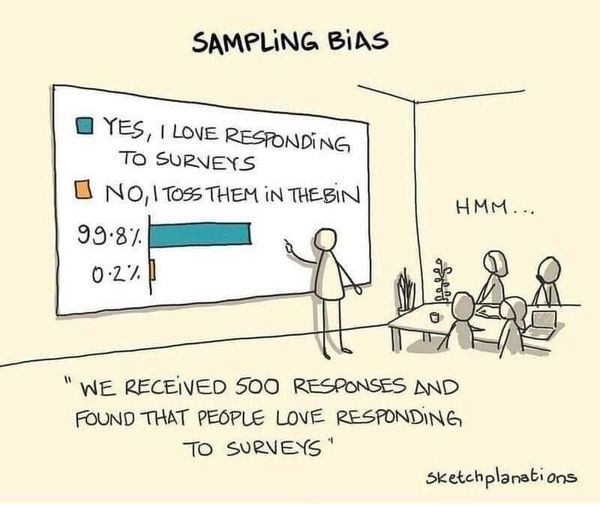
Selection Bias is the result of poor sampling techniques37 whereby we use partial and skewed data in order to back up our beliefs. It includes confirmation bias which is the unfortunate way in which us Humans tend to notice evidence that supports our ideas and we tend to ignore evidence that contradictions it38,39 and actively seek out flaws in evidence that contradicts our opinion (but automatically accept evidence that supports us)40,41. We are all pretty hard-working when it comes to finding arguments that support us, and when we find opposing views, we work hard to discredit them. But we don't work hard to discredit those who agree with us. In other words, we work at undermining sources of information that sit uncomfortably with what we believe, and we idly accept those who agree with us.
“If we believe a correlation exists, we notice and remember confirming instances. If we believe that premonitions correlate with events, we notice and remember the joint occurrence of the premonition and the event's later occurrence. We seldom notice or remember all the times unusual events do not coincide. If, after we think about a friend, the friend calls us, we notice and remember the coincidence. We don't notice all the times we think of a friend without any ensuing call, or receive a call from a friend about whom we've not been thinking.
People see not only what they expect, but correlations they want to see. This intense human desire to find order, even in random events, leads us to seek reasons for unusual happenings or mystifying mood fluctuations. By attributing events to a cause, we order our worlds and make things seem more predictable and controllable. Again, this tendency is normally adaptive but occasionally leads us astray.”
"Social Psychology" by David Myers (1999)38
Our brains are good at jumping to conclusions, and it is often hard to resist the urge. We often feel clever, even while deluding ourselves! If a bus is late twice on a row on Tuesdays whilst we are stood there waiting for it, we try to work out the cause. We would do much better to accurately note on how many other days it is late, and note how many times it isn't late on a Tuesday. But rare is the person who engages methodically in such trivial investigations. We normally just go with the flow, and think we have arrived at sensible conclusions based on the data we happen to have observed in our own little bubble of life.
All of this is predictable enough for an individual, but another form of Selection Bias occurs in mass media publications too. Cheap tabloid newspapers publish every report that shows foreigners in a bad light, or shows that crime is bad, or that something-or-other is eroding proper morality. And they mostly avoid any reports that say the opposite, because such assuring results do not sell as well. Newspapers as a whole simply never report anything boring - therefore they constantly support world-views that are divorced from everyday reality. Sometimes commercial interests skew the evidence that we are exposed to - drugs companies conduct many pseudo-scientific trials of their products but their choice of what to publish is manipulative - studies in 2001 and 2002 shows that "those with positive outcomes were nearly five times as likely to be published as those that were negative"42. Interested companies just have to keep paying for studies to be done, waiting for a misleading positive result, and then publish it and make it the basis of an advertising campaign. The public have few resources to overcome this kind of orchestrated Selection Bias.
RationalWiki uses mentions that "a website devoted to preventing harassment of women unsurprisingly concluded that nearly all women were victims of harassment at some point"43. And another example - a statistic that is most famous for being wrong, is that one in ten males is homosexual. This was based on a poll done on the community surrounding a gay-friendly publication - the sample of respondents was skewed away from the true average, hence, misleading data was observed.
The only solution for these problems is the proper and balanced statistical analysis, after actively and methodically gathering data. Alongside raising awareness of Selection Bias, Confirmation Bias, and other thinking errors. This level of critical thinking is quite a rare endeavour in anyone's personal life - we don't have time, the inclination, the confidence, or the skill, to properly evaluate subjective data. Unfortunately fact-checking is also rare in mass media publications. Personal opinions and news outlets ought to be given little trust.”
"Selection Bias and Confirmation Bias: 1. Poor Sampling Techniques" by Vexen Crabtree (2017)
6. Explaining Our Experiences44
#delusion #experience #psychology #thinking_errors
We have an internal narrative in our heads, which we subconsciously create to constantly describe and explain our own actions, and our own perception of the world. But there are many occasions where the stories that it creates are mistaken, and sometimes even completely fabricated45,46. This is a subconscious self-deceit, and to guard against it is difficult. Neurologists and psychologists have amassed a great number of example cases. For example, after temporary surgery direct electrical stimulation of the brain caused one patient (George) to turn his head sharply whenever the trigger was set. Even though George didn't know the true cause, he explains to the doctor that he is "looking for my slipper" and "I heard a noise" and then "I'm restless"47. His brain creates a false reality for him. In another experiment, a hypnotized patient removes her shoes when given a secret clue. "Sarah," asks the hypnotist, "why did you take off your shoes?" "Well... my feet are hot and tired," Sarah replies. "It's been a long day"47. It's not just ordinary experiences that can be convincingly mis-interpreted by our brains. Hallucinations, out of body-experiences, the feelings of being watched and of a spirit standing nearby, can all be generated electrochemically in artificial experiments on the brain45. These phenomena are interpreted by some people as anomalous and strange, but other people are easily misled by biochemical dysfunction into sternly held supernatural beliefs. The conditions for such spontaneously and real-seeming events can occur at any time; and an untrained mind can easily be led astray.
For more, see:
7. Shamanism: Altered Consciousness and the Afterlife48
#afterlife #christianity #death #indonesia #pakistan #shamanism #singapore
See: "Shamanism" by Vexen Crabtree (2015)
Different Truths Learned from Altered Consciousness:
Shamanism is built on the experience of altered states of consciousness. These are brought about through trances, dances, the delirium of sickness and heat exhaustion, rituals, epileptic fits and schizophrenic episodes. But most of all, psychotropic drugs were consumed via eating psychoactive parts of plants and other hallucinogens, such as peyote, ayuesca, ibogaine and fly agaric mushrooms.49,50
The effects of shamanic trances and dances have not gone unstudied. Czech psychiatrist Stanisav Grof developed a technique "called 'holotropic breathwork', which involves lengthy sessions of altered breathing combined with music" which was found to be able to alter oxygen levels and brain functioning to the extent that it produced similar experiences as those experienced through the use of LSD51. Our brains require a constant and steady amount of oxygen and blood sugar in order to function properly. Our frontal cortex, responsible for moods, is especially sensitive. Trance states and special breathing exercises can induce strange experiences, which, devoid of any understanding of how our brains work, are often interpreted as having spiritual, magical or otherworldly meaning.
In Pakistan, shamans (the dehar of the Kalash Kafirs) do it by standing motionless and concentrating on an altar until they develop tunnel vision, then by shaking and jerking52. In Indonesia, it is done during dreams or states of sickness52. "Meanwhile, in the Mentawei Islands near Sumatra, shamans dance until they fall into a state of trance. They are then borne up into the sky in a boat carried by eagles where they meet sky spirits and ask them for remedies to treat disease"52. Traditional Eskimo shamans use drumbeats or "lace their arms and legs tightly to their bodies to hasten the release of the inner light-force"52. A mixture of physical effects and mental effort to produce these states is similar to mystics and spiritualists across the world. But is there any truth in the shamanistic interpretation of these experiences?
The variety of beliefs and practices tell us very little about the nature of spirits. But the variety of experiences do seem to describe very well the various states of the human mind that cause psychedelia in general: hippies do it with acid, Pentecostal Christians do it in Church (just like shamans in Singapore who become a shaman by displaying spontaneous signs of spirit possession during temple ceremonies52), and sufferers of night terrors do it with demons in their beds at night. In each time and place, these similar experiences are interpreted radically differently depending on the local culture. Is it really the case that all those other cultures' supernatural explanations are wrong, and one particular supernatural explanation is correct? It seems that the dark days of human ignorance have come to a close, and psychologists and neurologists offer the only explanations that are universal and true. Shamanism isn't to do with spirits, it is all about navigating the world in a pre-scientific way.
The morning-glory species Rivea corymbosa contains a drug similar to LSD, and is considered sacred by South American shamans - although note that "in 1651 a Spanish physician wrote that Aztec priests ate morning-glory in order to receive messages from the gods"53. But there is a question to be asked here. Why would gods talk to Aztec priests, when in general, other shamans maintain that it is animal spirits that speak to shamans, as a result of the same drug? It seems strange that one group of people think they are talking to gods, and another group of shamans think they are talking to animals. If this was true, wouldn't some animal spirits speak to Aztec priests and tell them that they're ancestors, not gods? Or wouldn't some gods talk to shamans and tell them that they're not ancestors? This division along cultural lines tells us that both groups of people are misinterpreting the psychedelic effects of the drug they are taking. At least, in this, the average hippie was much closer in appreciating the truth: drugs were interesting, but not a source of absolute reality. If reality could be spied through these drugs, then shamans, Aztec priests and hippies would have discovered the same underlying reality, not three radically different ones!
Differing Experiences of the Afterlife:
“
In Siberia the Shamans know that the dead enjoy lives in the underworld that are very much like the living: they hunt, they fish, and they chatter to relatives. After people's death, Shamans must actually help a spirit get into the underworld, else they become lost spirits, causing problems for the living.54,55. Such a contrast to the deluge of Christian mystics with their heaven and hell - where spirits cannot be guided, and god sends spirits to the right place. At least one of those two groups of people is completely wrong about their culture's entire experience of the spiritworld and of the afterlife.
Siberian Shamans' knowledge of the afterlife also contradicts the experiences of North American Shamen. Versluis documents how many North American tribes believed in a sky realm where people lived happily after death (where the seasons were also reversed), and a world below for "those who are punished in the afterlife"56. And in another complete divergence from the spiritual truths known outside of America, Thunder Cloud was a Shaman from Winnebago who "maintained that he was able to consciously recall two previous incarnations. In the second he actually watched the people burying him after his death"57. Therefore, reincarnation was the destiny of the dead. It is not the case that we could declare that in reality, some spirits get lost, most go the underworld, and some are reincarnated. That's not what Shamanism teaches us. Those who can soul travel and actually talk to spirits are told by the spirits what the score is with afterlife. So why it is that in North America, Shamen find themselves reincarnated, but no Shamen elsewhere have discovered this? And why do the spirits of the underworld not correct the errors of North American Shamans, and tell them that actually spirits need guiding to the underworld, else they get lost? And why do Apache indians think that ghosts return in the form of owls? These contradictions in beliefs teaches us one main thing: these believers are not in touch with any reality except that which their local culture has taught them. A lot of people are simply wrong about the beliefs that they cherish, and beliefs that are backed up with strong personal and cultural testimonies.”
8. Abstract Man
Abstract thought allows us to take things to extremes. We can feel love for people who we have never seen based on their personality and communication alone. The communication medium is irrelevant. Due to our increasing capacity for empathy, we feel that others love us in return and feel we are in touch with their emotions. This is based on the feelings we have towards them, based on our own abstract thought and these are all in turn all based on our assumptions on the relationship between what is real and what is abstract.
“It is important to understand that an enormous amount of our human experience is really a response to symbols. [...] This is the peculiarity of human beings: that a symbol can gain a hold on the imagination and cause a more powerful response than the actuality that it represents.”
"The Occult" by Colin Wilson (1971)58
It is possible to create an abstract personality, based on abstract thought processes, like politics and religion, but based around a concept or idea. If we symbolize and abstract an all-knowing parent into a timeless, deathless, figure, then some find God itself.
Our need for unconditional love, our abstract philosophical minds and the way our very emotions and world view are led by our abstract representations of what we think is real can conspire to create in our minds an abstract source of love. Something we want and need since youth, and something that can frequently be lacking. The all-loving abstract god, the all-knowing and all-powerful being that we create in our minds matches all of those abstract ideas we attribute with our parents while young.
Such want and expectation, especially combined with the popular cultural memes of God-belief do lead to experiences of 'God'. That this occurs is not a valid argument against the possible existence of God, but surely places much of the belief in God on the same plane as belief in conspiracy theories and mass hysteria.
I spoke of the convincingness of these feelings of reality, and I must dwell a moment longer on that point. They are as convincing to those who have them as any direct sensible experiences can be, and they are, as a rule, much more convincing than results established by mere logic ever are. [...] Probability is that you cannot help regarding them as genuine perceptions of truth, as revelations of a kind of reality which no adverse argument, however unanswerable by you in words, can expel from your belief.”
"The Varieties of Religious Experience" by William James (1902)59
It is very much clear to some psychologists that the meaning and emotional abstractions that we make, due to our biochemical makeups and history (culminating as our phenotype), diffuse the world with meaning that is just as real as the cold concrete data our mere senses provide us with. Our assumptions and humanity make us experience meaningfulness and presences where reality itself doesn't.
Importantly, and this is something that I will definitely testify to, William James notes that mere logic is often much less convincing to people who have had wild experiences without knowing what causes them. Logical argument will not work because their experience is real to them - if logic says it isn't real, there is probably something wrong with the logic. In my understanding, revealing the potential valid causes of the experience and explaining the biochemistry or psychology of it can have two affects:
- Patronize them (unfortunately).
- Make them realize their experience has ordinary causes.
It's a fine line trying to balance between the two, but when people have experienced irreconcilably different versions of reality it can put a strain on their social relations!
9. Concluding: Errors in Thinking, and Preventative Steps
#beliefs #pseudoscience #psychology #thinking_errors
We all suffer from systematic thinking errors60,61 which fall into three main types: (1) internal cognitive errors; (2) errors of emotion62, perception and memory; and (3) social errors that result from the way we communicate ideas and the effects of traditions and dogmas. Some of the most common errors are the misperception of random events as evidence that backs up our beliefs, the habitual overlooking of contradictory data, our expectations and current beliefs actively changing our memories and our perceptions and using assumptions to fill-in unknown information. These occur naturally and subconsciously even when we are trying to be truthful and honest. Many of these errors arise because our brains are highly efficient (rather than accurate) and we are applying evolutionarily developed cognitive rules of thumb to the complexities of life63,64. We will fly into defensive and heated arguments at the mere suggestion that our memory is faulty, and yet memory is infamously unreliable and prone to subconscious inventions. They say "few things are more dangerous to critical thinking than to take perception and memory at face value"65.
We were never meant to be the cool, rational and logical computers that we pretend to be. Unfortunately, and we find it hard to admit this to ourselves, many of our beliefs are held because they're comforting or simple66. In an overwhelming world, simplicity lets us get a grip. Human thinking errors can lead individuals, or whole communities, to come to explain types of events and experiences in fantastical ways. Before we can guard comprehensively against such cumulative errors, we need to learn the ways in which our brains can misguide us - lack of knowledge of these sources of confusion lead many astray67.
Learning to think skeptically and carefully and to recognize that our very experiences and perceptions can be coloured by societal and subconscious factors should help us to maintain impartiality. Beliefs should not be taken lightly, and evidence should be cross-checked. This especially applies to "common-sense" facts that we learn from others by word of mouth and to traditional knowledge. Above all, however, our most important tool is knowing what types of cognitive errors we, as a species, are prone to making.