Abortion, Birth Control and Contraception
https://www.humantruth.info/birth_control.html
By Vexen Crabtree 2013
- Religion and Population Growth
- The Necessity of Birth Control and Contraception and the Opposition of Religious Organisations
- Condom Promotion vs. Harmful Ideology
- Abortions
- The Catholic Church's Eternal and Absolute Truth
- How Faulty Teachings on Sexuality Lead to Faulty Society
- Links
1. Religion and Population Growth1
#climate_change #environmentalism #population #religion_and_climate_change #religion_and_population
Whilst much of the world is fighting bitterly to reduce the harm we're doing to the planet, the most religious countries are still growing their populations at staggering rates2,3. Different religions have had various stances on procreation: the Cathars considered the world so corrupt that they abstained from all sex4,5. But religions that had a doctrine of having as many babies as possible were always destined to be successful for simple Darwinian reasons: The largest organized religions today are all anti-birth-control, often using their weighty influence and resources to oppose birth control, prevent family planning and restrict women's rights. They are most successful in developing countries that lack strong governments, where women's rights are poor, and in countries where religious groups loom large in the education sector. Together, these campaigns are doing immense harm to the planet, to human society, to womankind and to our future generations.
For more, see:
2. The Necessity of Birth Control and Contraception and the Opposition of Religious Organisations
#AIDS #birth_control #contraception #disease #dogma #health #hiv #philippines #pope #population #procreation #rcc #religion #religion_sex #sex #sexuality #STDs
Few people doubt the severity of the problem that overpopulation presents for this planet. Its consequences are poverty, famine, disease and death, sometimes on very large scales. Minor problems include overcrowding, strained infrastructure and social instability. By facilitating contraception and women's medical services we enable family planning. "Allowing women to plan their pregnancies also leads to healthier outcomes for children. A recent study showed that if all births were spaced at least two years apart, the number of deaths among children younger than five would decline by 13%. The number would decline by 25% if there were a three-year gap between births"6. Making birth control accessible to all is a moral requirement for anyone who has the power to help. It is inconsistent, for example, to say that contraception and abortion is "murder" whilst ignoring the fact that poverty and overpopulation are far bigger killers.
Aside from population control, "the health benefits of contraceptive use are substantial. Contraceptives prevent unintended pregnancies, reduce the number of abortions, and lower the incidence of death and disability related to complications of pregnancy and childbirth"6. The numbers of abortions that are prevented by contraception is staggering. A Guttmacher Institute report on the developing world predicts that "in 2012, use of modern contraceptives in the developing world will prevent 218 million unintended pregnancies, which, in turn, will avert 55 million unplanned births, 138 million abortions (40 million of them unsafe), 25 million miscarriages and 118,000 maternal deaths. It will also prevent an estimated 1.1 million neonatal deaths (those within 28 days of birth) and 700,000 postneonatal infant deaths (those from 28 days to one year of age)"6. Condoms help prevent the spread of disease - their effect is strong enough that long-term use by a community can gradually eradicate strains of sexually transmitted diseases from the community. Venereal disease causes unimaginable suffering and can affect the purely innocent. Babies are frequently infected with the diseases of the parents; in this way, the prevention of disease with contraception is vital because once women in a local area are infected with a disease, children will also be directly infected. In the case of incurable diseases, such an event can lead to unsurmountable suffering. Such a terrible state of affairs is prevented by the correct use of contraceptives such as condoms. The number of women with unmet needs for contraception in the developing world is still increasing - between 2008 and 2012 the figure rose from 153 million to 162 million6. Those 69 countries are the ones that are least able to support growing populations.
“Some of the religious traditions have presented recurring obstacles to open discussion of certain kinds of birth control at UN population conferences. These religious groups are associated largely with Islam, Roman Catholicism, and evangelical Christianity.”
"Religion and Ecology"
Mary Evelyn Tucker (2011)7
Religious opposition to abortion, birth control and contraception: Despite the practical necessity of birth control, the benefits of disease prevention, the moral responsibility we have towards the future of our children and the responsibility we have with regards to the stewardship of our planet, many religions have opposed birth control for various superstitious reasons. On the other side of the fence, it is worth knowing that all of the pioneers of contraception were freethinkers8,9 (that is, people who are opposed to the influence of organized religion on people´s opinions and beliefs). Why have religions determined to prevent family planning? The answer is in a kind of survival of the fittest amongst religions themselves. As most religious people simply abide by the religion of their parents10, religions that encourage parents to have more children will attain a stronger and longer-lasting base of adherents. Barber (2011) notes that religions promote fertility by encouraging marriage at a much earlier age than amongst the non-religious11.
Bearing this out is Catholicism, which has an infamously strict suite of dogmas that forbid all kinds of birth control. The Roman Catholic Church is the most notable, powerful and active organisation that lobbies against birth-control wherever it can, internationally. Thankfully Most Catholics routinely ignore the Church on this issue, especially in educated and developed countries, but there are still plenty of fast-growing countries where the Catholic Church is still prospering the old-fashioned way. It took the government of the Philippines 13 years to force through legislation to allow government-funded contraception and for sex education in schools because of the strength of the opposition of the Catholic Church there - in a country where 11 women die of pregnancy-related problems every day. The Catholic Church "ferociously" opposed it, warning of moral and social collapse, the destruction of family life, and divine wrath, if it was passed. The bill is considered "a major step toward reducing maternal deaths and promoting family planning in the impoverished country, which has one of Asia's fastest-growing populations. [...] The United Nations said early this year that the bill would help reduce an alarming number of pregnancy-related deaths, prevent life-threatening abortions and slow the spread of AIDS"12.
Source:13
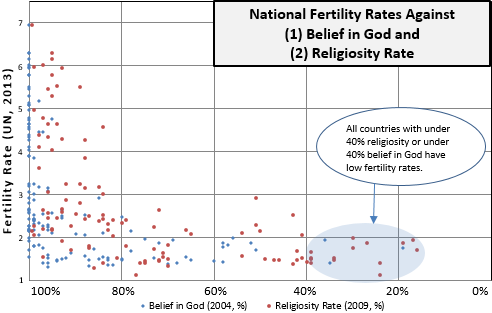
The graph to the right can be clicked to view the full size version. It shows that the effects of religious prohibitions against birth control are clear on the international scale. No country that is either less than 40% religious, or has less than a 40% rate of belief in God, has a fertility rate of over 2.0. Conversely, every country that has a fertility rate of over 3.0 is over 80% in terms of both belief in God and in the rate at which they say they are religious.
On account of all of this, in "Why I am not a Christian" by Bertrand Russell (1957)14 the author takes a moral stance against the Church:
“I begin with contraception, because here the influence of superstition is particularly noteworthy. [...] If either of the parents has venereal disease, the child is likely to inherit it. If they already have too many children for the family income, there will be poverty, underfeeding, overcrowding, very likely incest. To please [the anti-contraception religious types] a life of torture is inflicted upon millions of human beings [...] merely because it is supposed that sexual intercourse is wicked unless accompanied by desire for offspring. [...] If they had even the smallest spark of love or pity for children they could not adhere to a moral code involving this fiendish cruelty. [...]
To be killed suddenly and then eaten, which was the fate of the Aztecs' victims, is a far less degree of suffering than is inflicted upon a child born in miserable surroundings and tainted with venereal disease. Yet it is the greater suffering which is deliberately inflicted by bishops and politicians in the name of morality.”
"Why I am not a Christian" by Bertrand Russell (1957)8
Simple contraceptive measures such as condoms can be used to prevent long-term suffering and control population growth, but also endows families with shorter term relief from suffering, and it is for these reasons that Bertrand Russell above states that Aztec cannibalism produced less suffering than anti-birth control lobbyists. The availability of methods to control family size is one of the biggest factors in being able to escape poverty.
“In the world as a whole, a stunning 135m people escaped dire poverty between 1999 and 2004. [...] More people, more quickly than at any other time in history. [...] Perhaps the biggest change affecting people's lives has little to do, at least directly, with development policy or public spending. People in poor countries are now able to exert more control over their own fertility, and hence over the size of their families.”
The Economist (2008)15
Aside from statistical commentary, it is often individual cases that can educate people about the need, however unfortunate, for abortions to be available at proper medical institutions. Neil J. Kressel16 relates a story about an American woman who "now believes abortion rights are an important component of American civil rights and that physicians have a moral obligation to make them available, even if at considerable risk to themselves. [...] Her change of heart came partly from experiences during her medical training, including one occasion when she had to counsel an eleven-year-old girl. The doctor recalls: '[I]t soon became obvious that she had no understanding of sex - she didn't really understand that she'd even had it, or that it had any connection to her pregnancy"17. In the real-world, the moral arguments are strongly in favour of those who defend the right of women and doctors to be able to freely use abortion as one of their possible methods of preventing harm.
3. Condom Promotion vs. Harmful Ideology
3.1. Anti-Condom Pseudoscience
Condoms are scientifically proven to be superior methods of preventing the spread of sexually transmitted diseases and are effective methods of birth control18. But, for superstitious reasons, some religions such as the Catholic Church and a mixture of other fundamentalist groups have run (and still run) long campaigns against their use19. Their ideology not only prevents them from using effective anti-disease contraception, but it causes them to also (a) deny its effectiveness (b) emphasize problems with condoms and (c) actively campaign against others' use of it, and even to the extent of sabotaging the distribution of condoms. Catholic agencies in Africa have committed such horrors as instructing all condoms to be stapled (piercing them), and Christian leaders are regularly caught teaching that condoms don't work and recently, that Westerners are distributing HIV-ridden condoms that will give their users AIDS. (HIV is the virus that causes AIDS, but, neither survives outside the body so such stories are misinformed, let alone paranoid).
3.2. Abstinence-Only Sex Education
Christian mythology asserts that God prefers Homo Sapiens (but no other species) to have legal contracts with each other (marriage) in order to procreate. Conservative Christians often talk about "abstinence-only" education, and in many states in the USA have conducted battles to stop schools from educating children about safe sex. Instead, they teach, that in order to be responsible Christians adults, you have to abstain from sex until marriage.
“In the US and elsewhere, 'Just Say No!' campaigns promote sexual abstinence, while unmarried young people with a sexual past are encouraged to become "born-again virgins" through a pledge to refrain from further sexual activity until marriage. However, such programmes have generally been unsuccessful in radically changing sexual behaviour or in reducing rates of HIV/Aids transmission, as health evaluations have demonstrated.”
"Sexuality: A Very Short Introduction" by Veronique Mottier (2008)20
But, whether or not abstinence-only works can be tested and studied. "Studies have found that abstinence-only sex education programs actually increase the rates of pregnancy and STDs in the teenage population"21. "Kirsten Underhill and her colleagues at the University of Oxford have, over the past few months, been testing it"22. Their studies involved 16 000 young people in America and compared Christian abstinence-only education with no (or low key) education.
“Pregnancies were as numerous in both groups. Sexually transmitted diseases were as widespread. The number of sexual partners was equally high and unprotected sex just as common. [...] In contrast to the fears of the protagonists of abstinence-only-education, not one of the trials found that teenagers behaved in a riskier fashion in either the long or the short term after receiving [condom] instruction.”
The Economist (2007)23
However in 2009 new data revealed that in the USA at least, abstinence-only education was not only ineffectual, but was actually making things worse:
“To the surprise of few outside the rarefied world of the Religious Right, it has emerged that George W Bush's "abstinence only" policies led directly to a rise in teenage pregnancies and sexually transmitted diseases. The Centres for Disease Control (CDC) says that after years of falling rates, teen pregnancies and STDs started rising after Bush was re-elected in 2005.
According to the CDC, birth rates among teenagers aged 15 or older had been in decline since 1991 but rose sharply in more than half of American states after 2005. The number of teenage girls with syphilis had risen by nearly half after a big decrease, while a 20-year fall in the gonorrhea infection rate was being reversed. AIDS cases in adolescent boys had nearly doubled. [...]
The number of teen pregnancies is double in areas where abstinence is the only method of birth control taught as opposed to areas where there is comprehensive sex education and condoms are handed out. [...] Religious proponents of the "abstinence-only" policies still insist that the reason for the rise is because their policies were not promoted hard enough.”
National Secular Society (2009)24
The Bible-belt is a swathe of Southern states in the USA famous for their embrace of tough Christianity. It was here, where abstinence-only programmes are popular, that the CDC reported the highest rates of teenage pregnancy and STDs.
In conclusion:
Condoms excel at preventing sexually transmitted diseases, and, educating people about safe sex and condom use does not lead to increased promiscuity.
Abstinence-only education does not work and has led to increased rates of teenage pregnancy and STDs.
4. Abortions
#birth_control #sexuality #uganda
The best ways to prevent abortion are increased education25, increased (and more equal) chances in life for women, less poverty and fewer legal restrictions on abortion. In developed countries where abortion is legal, rates drop. Where it is illegal or heavily restricted, and where it goes against popular religion's beliefs, the rates of illegal abortions are high (possibly made worse by women's education being poor in strongly religious communities). Unwarranted restrictions on abortion result in millions of women each year suffering from medical complications as the result of having to obtain illegal "back street" procedures; 70,000 of those women die annually as a result26.
“A new report by the Guttermacher Institute, a pro-choice think-tank [examines how] prohibitions on abortion are slowly easing, though poor countries remain much tougher than rich ones. Since 1997, 22 places have changed their abortion laws and in 19 of those cases the change was a liberalisation. [...] In Western Europe, which has among the most liberal laws in the world, abortion rates are the lowest. Places where abortion is in effect banned, such as Uganda, typically see the highest incidence of abortion.”
The Economist (2009)26
5. The Catholic Church's Eternal and Absolute Truth
#christianity #christianity_sex #poland #USA
The Abrahamic religions, Judaism, Christianity and Islam, embody a wide range of opinions and practices on contraception. In the 1920s, most Christian denominations, including both Protestants and Catholics, were against birth control and contraception27. According to a Catholic website, "At its 1930 Lambeth Conference, the Anglican church, swayed by growing social pressure, announced that contraception would be allowed in some circumstances. Soon the Anglican church completely caved in, allowing contraception across the board. Since then, all other Protestant denominations have followed suit"28. In modern times it is the Catholic church that is most famously and strongly against the use of contraceptives, even for the use of disease prevention. But whilst the official doctrine as propounded from the pulpit is strict; condemnations of contraceptive use are widely ignored on the ground. Even in Poland, Europe's most Catholic country, "many are openly defying its rulings on contraception and abortion"29. Hindus are free to employ birth control methods as they see fit.
Any conscientious priest in the Catholic Church should consider openly declaring dissatisfaction with the Vatican's anti-human and anti-equality policies. Mother Theresa, one of the other "good guys" who has rabidly opposed condoms, spent millions flying to and fro in Europe and the USA on political campaigns against contraceptives. The Catholic Church, with all its money, could turn itself into a force for good and squarely put the dark ages behind itself, but, riddled with superstition and religious inhibitions, it is still a dangerous and dysfunctional failure, crippled by delusions about the real world.
5.1. The Absolute Truth until 1930: All Birth Control Methods are Wrong
#birth_control #christianity_sex
The Catholic Church has heavily opposed all forms of birth control for all of known history. The current document is Pope Paul VI's Humanae Vitae (1968)30, reflecting the opinion of Pope Piux XI in 1930 that the Catholic Church teaches absolute truth as passed down 'uninterruptedly from the beginning'31. Between 1816 and 1916 there were twelve separate condemnations of contraception issued by the Catholic Church's Sacred Penitentiary27. One thing is clear: For much of its history, the Catholic Church has strongly opposed contraception. In particular, it has opposed any method that intentionally prevents childbirth between a married man and woman.
5.2. The Absolute Truth from 1930: The Safe Period Method is OK
#birth_control #christianity_sex
Despite this clear, long-standing and impractical standing, things slightly changed in 1930. The eternal truth passed down and taught by Catholics "from the beginning", slightly changed for the better, and the Casti Connubii allowed, in extreme situations, couples to use the 'safe period' or 'rhythm' method. This inaccurate method hardly works and doesn't stop the spread of disease, but, nonetheless, the position of the Catholic Church changed a little. This change in absolute, eternal doctrine of the infallible Pope (get the sarcasm?) was confirmed twice by Pope John XXIII in 1951.
5.3. Immoral
#christianity_morality #christianity_sex
It is no wonder that Bryan Wilson, in his discussion of how Christian Churches have followed society, but lagged behind (therefore undermining their own claims of doctrinal moral truth), uses the history of birth control as his main example of the changes in society that have led to changes in Church doctrine32.
43% of Roman Catholic priests in England & Wales do not support the Church's ban on contraception (another 19% are unsure)
Newsline (2003)
All of this so far would be merely an academic curiosity, another example of zany religious clerics making odd declarations based on ever odder historical precedents. But The Catholic Church is also a heavy activist, and has caused uncountable numbers of poor people in South America and Africa to become infected with HIV and other STDs, contributed to the dangerous population explosion, and undermined charity organisations that support birth control, such as when the Birmingham Catholic Church boycotted Comic Relief because money raised might go to a family planning clinic that gave access to contraceptions to street children33. The Catholic Church causes very real suffering amongst very poor people as a result of its impractical policies.
5.4. Catholic Church Opposing Condoms in Africa, Despite HIV Threats
Africa suffers massively from HIV and AIDS, and is the continent that saw the first cases. 20 million people have died from AIDS in Africa and a further 22.5 million are infected with HIV. Many are born with it, as it often passes from mother to baby, and due to the nature of HIV, many people can have the virus but remain without symptoms, sometimes for decades.
The Catholic Church still strongly opposes the use of condoms in Africa, which is home to 135 million Catholics34. In Kenya, local Bishops have instead recommended that abstinence, "counseling" and "ethics" are used to prevent the spread of HIV, instead of condoms. The Catholic Church has run long-term campaigns against condoms. Dr Muga, Kenya, said that the government has reduced infection rate from 14% to 10% as a result of sex education and condom contraception, but still, the Catholic Church campaigns against sex education that teaches the value of contraception. Bishop Korir said that only the guilty were afraid and resorted to condoms, and that he wanted "no condom talk" (2003)35. Those who are born with it, or are infected with it because a partner unknowingly had it, are not exactly 'guilty'!
You might think that such crazy Bishops are a phenomenon peculiar to Africa. But the doctrine against condoms comes from the top, and the Vatican's official long-standing policy is propounded even in Europe and the USA. Pope Benedict, the German head of the Catholic Church from 2005 to 2013, delivered speeches in Africa in 2009 and reiterated, in the 21st century, his stance against condoms:
“Asked about the use of condoms to help tackle the scourge of AIDS, the pope restated, in unusually explicit terms, the church's position that these are not useful to "overcome" the epidemic, indeed their use actually makes the problem worse. He suggested the disease could be beaten through chastity, abstinence and "correct behaviour". [...] His statement sounded otherworldly at best, and crass and uncaring at worst. Merely wishing away human sexual behaviour does nothing for the potential victims of AIDS, many of whom are innocent under even the most moralistic definition of that word.”
The Economist (2009)34
In countries where the authorities are weak, science is ill-established and there are mass social problems, it would help a lot if the Catholic Church, with its powerful social networks, joined in with the efforts to stop the decay of society due to disease and overpopulation (two things that go hand-in-hand). But governments in Africa and South America, not to mention the USA and European countries such as Poland, have to fight against the church on such simple measures as birth control and condom use, and this battle often politicizes the operations of charities and welfare groups.
6. How Faulty Teachings on Sexuality Lead to Faulty Society
#birth_control #buddhism #christianity #hinduism #judaism #new_age #religion #religion_morals #religion_sex #sexuality #turkey
The high child abuse and sexual abuse rates within the Christian priesthood highlight a problem that many religions face: We should not attempt to mould human sexuality around otherworldly religious ideals. Sexual dysfunction always results. Psychologists and sociologists have noted the association between extreme religious fervour and psycho-sexual problems (the former causing the latter), and the highly negative stance that many monotheistic religions take towards sexuality in general have contributed to a general malaise amongst their lay adherents, and a serious pandemic of abuse amongst professional religionists. The religious attitude towards religion is to behave like an ostrich and stick its head in the sand, hoping that theology can override biological truth, but merely making its victims unable to cope with adult sexuality. Witness the hateful and confusing statements that Christians and Muslims make about homosexuals, the anti-contraception stance that the Catholic church has in an over-crowded world ridden with disease, the harmful and simplistic rejection of abortion and the patriarchal dominance over women that has gone hand-in-hand with traditional religion on every continent.
Many religious practices are somewhat more positive towards sexuality than Christianity. The scholar Veronique Mottier gives the example of Judaism, which disapproves of abstinence36. Karen Armstrong reminds us that "Certain sects in Buddhism and Hinduism have used sex as a mystical activity. Everybody has heard of the Karma Sutra but not everybody is aware that this is not just a sex manual, but a method of achieving transcendence and spiritual enlightenment. Christianity is unique in having hated and outlawed sex and in making people feel guilty because they are sexual beings"37. But it is not just the subject of sex which is important to a discussion on sexuality - it still must be remembered that all traditional religions have normalized the dominance of men over women, and often obsessed over matters such as female dress.
In the modern world, many modern popular movements provide an alternative to traditional religions, and have enshrined normal sexuality. The secular world merely lets sexuality remain natural, and the New Age movement amongst many others, actively engage sexuality. The results have been much more positive and healthy than those of the classical monotheistic religions. This is one reason why countries that have liberal laws on abortion also have much lower rates of abortion than highly religious countries that restrict abortion heavily. An atmosphere of taboo and restriction serves limits responsible sexual behaviour. Rather than an ostrich, be a peacock!
For more, see:
There are many still in the world who embrace the more traditional, unfair and damaging ideas towards women. In 2016 Mar, Turkish president Recep Tayyip epitomized the traditional and established opinion of "woman's place" in Turkey, repeating several slurs against modern gender equality. He managed to include a criticism of contraception in general, saying that it is used to 'dry up our nation'. Contraception and modern life 'paves the way for abuses against women in all fields' and in particular, capitalism 'enslaves' women for profits. What he's talking about is (1) women making choices as to when they want children, and (2) women being able to work. Tayyip doesn't support either right and he has repeatedly called on Turkish women to have at least 3 children, even in a country that is suffering from overpopulation and serious issues with quality of life. He has described abortion as 'murder' and Caesarean sections as unnatural. His embarrassing and backwards opinions are holding back the entire country.38 But there are many who resist, and help move humanity forwards. In a recent talk at the Women Worldwide Advancing Freedom & Equality event, the invited speaker Naomi Phillips spoke on women's reproductive rights and said that although secularism doesn't guarantee fair rights for women, it is still a necessary prerequisite simply because of the limiting harm that religion has so far done; the biggest threat to such rights still come from strict religion-based lobby groups.39
