The Worth of Experts and Specialists
https://www.humantruth.info/specialisms.html
By Vexen Crabtree 2025
The world is complex. We constantly discover that social and physical phenomenon are more complex than we first thought, that our 'common-sense' opinions are not up to scratch1,2. In any given field, the amount of research required to understand what's going on means that we have to specialize2,3,4.
The philosopher Immanuel Kant spoke of the advantages of developing expertise over a long period of time, and conversely warns that failure to do so "only produces bunglers"3 - a generalist with a bit of knowledge is no match for someone who has devoted years of effort to a topic. Governments and leaders especially need to rely on expert advice from qualified and balanced advisors, if policies are ever going to be developed enough to deal with reality5.
But we are not good at recognizing, promoting or rewarding those who dive deeply into research and skeptical thinking; academics are "paid significantly less than ordinary businessmen, athletes, movie stars, comedians, and entertainers"6 despite the good that specialist academics do for humankind.
- Complexity Requires Knowledge Specialisation
- Good Governance Requires Specialists
- Undervalued
- Expertise Doesn't Imply Extra-Curricular Wisdom
- Links
1. Complexity Requires Knowledge Specialisation
The advanced economist Joseph Schumpeter saw, in the 1930s, the transformation of much of the business world away from leadership by charismatic mavericks and insightful inventors. The ability of individual humans to come up with new technologies was rapidly decreasing, and in its place, teams of people dedicated to narrowly-focused areas of research were coming to be essential in the production of anything advanced.
“For, on the one hand, it is much easier now than it has been in the past to do things that lie outside familiar routine–innovation itself is being reduced to routine. Technological progress is increasingly becoming the business of teams of trained specialists who turn out what is required and make it work in predictable ways. The romance of earlier commercial adventure is rapidly wearing away, because so many more things can be strictly calculated that had of old to be visualized in a flash of genius.”
"Capitalism, Socialism, and Democracy" by Joseph A. Schumpeter (1942)7
But this isn't a new feature of humankind. Two hundred years before, Immanuel Kant philosophized over the benefits of having team members specialist in topics; and when specialists work together, they achieve efficiencies that it is simply impossible for generalists to achieve:
“All trades, arts, and handiworks have gained by division of labour, namely, when, instead of one man doing everything, each confines himself to a certain kind of work distinct from others in the treatment it requires, so as to be able to perform it with greater facility and in the greatest perfection. Where the different kinds of work are not distinguished and divided, where everyone is a jack-of-all-trades, there manufactures remain still in the greatest barbarism. [...]
[We are] warned not to carry on two employments together which differ widely in the treatment they demand, for each of which perhaps a special talent is required, and the combination of which in one person only produces bunglers.”
"Fundamental Principles of the Metaphysic of Morals" by Immanuel Kant (1785)3
2. Good Governance Requires Specialists
#democracy #good_governance #politics #rationalism #science #Scientific_Method #specialists #The_Enlightenment #UK
The Enlightenment brought to the fore the advantages of basing policies on evidence and a solid intellectual framework8: No longer were the pronouncements of forceful leaders enough; from then on, rulers must prove their case through convincing arguments based on facts and figures. This rationalist approach popularized the Scientific Method9, and the requirement for knowledgeable experts to stand alongside politicians and rulers. The German philosopher Immanuel Kant (1724-1804) described Enlightenment demands on government as being "the enthronement of reason in public affairs"10.
As rulers are prone to abuse their position for their own ends, power must be subject to checks and balances11. And to end the cyclic spectre of prejudiced sectarian government and religious division, government must be secular and tolerant - that is - neutral, on the topic of religion12. These threads all merged to form the liberal democracy that has proven itself as the best approach to statecraft we as a species has so far devised.
For more, see:
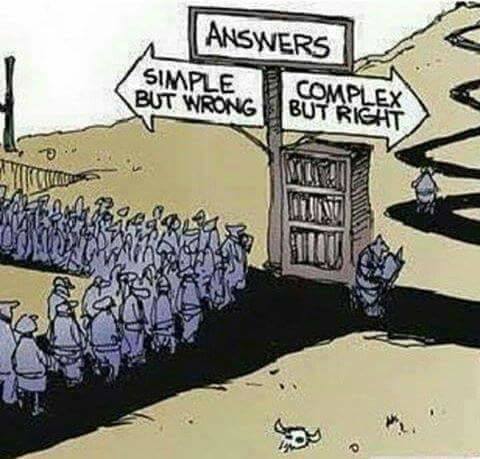
The world is complex, and many popular opinions (and slogans) are simply wrong2. The solution, even if unpopular, is to enable educated specialists to speak freely, to advise government, and to be listened to by the appropriate government departments. It is very poor management indeed to ignore and put-down expert opinion, especially as the public can be easily swayed into an anti-specialist sentiment, on account of the often counter-intuitive nature of informed facts.
In H, Kohn's description of the 'democratic way of life', this falls under the category of 'open minded critical enquiry'13. In an era where politics is being pulled away from depth analysis, David Nutt, a scientific advisor to the UK government, had to speak out for basic science, saying that being "willing to change our minds in the light of new evidence is essential to rational policy-making"14, a truism that the developed world has long since assumed to be a part of liberal democracy, but is today increasingly being trumped by popularist parties, with politicians desperate to find support even in poorly-thought-out policies which don't have proper evidenced support. Some of the lessons of the Enlightenment need to be relearned.
Schumpeter discusses this around the context of economics and crime. Our technical ability to describe and predict world economies by 1910 had become "much more correct although less simple and sweeping" and has moved away "from that happy stage in which all problems, methods and results could be made accessible to every educated person without special training"4. And the same with crime - our instincts and feelings alone lead to bad policy.
“Government and parliament will have to accept the specialists' advice whatever they may think themselves. For crime is a complex phenomenon. [...] Popular slogans about it are almost invariably wrong. And a rational treatment of it requires that legislation in this matter should be protected from both the fits of vindictiveness and the fits of sentimentality in which the laymen in the government and in the parliament are alternatingly prone to indulge.”
"Capitalism, Socialism, and Democracy" by Joseph A. Schumpeter (1942)2
Related topic: How to Govern Well
3. Undervalued
#human_progress #knowledge #specialists #trash_culture
Humankind faces some awesome problems - overpopulation, climate change, religious division, political division, social problems of equal opportunity and prejudice, technological complexity, inner problems of psychology and neurology - current trends have made all of these worse, and each requires its own batch of specialists in every country, working together to educate, inform and advise. But that's not what society itself wants. The vast majority of spending and public interest goes on entertainment, sports, celebrity-worship and nonsense. It is increasingly difficult for experts not only to find ears to talk to; the world of the do-gooders is dividing from the general population.
“Keep in mind that society already has a class of accomplished mathematicians and physicists, and they are paid significantly less than ordinary businessmen and wield much less power than average politicians. Being super smart does not guarantee financial success in life. In fact, being super smart may actually pigeonhole you in the lower rungs of a society that values athletes, movie stars, comedians, and entertainers more.”
"The Future of the Mind" by Michio Kaku (2014)6
4. Expertise Doesn't Imply Extra-Curricular Wisdom
#experts #intelligence #knowledge #science #specialisms #thinking_errors
Outside of their field of expertise, specialists can believe just as much nonsense as everyone else. In fact, if you are intelligent, it can be even harder to shake-off a crazy idea once it implants itself, because you are better at finding evidence for it. Hence, knowledge of the types of thinking errors becomes very important, but, is rarely researched nor taught in school.
Therefore: It is essential to consult the right kind of specialist, and, to allow that advisor to consult his own sub-specialisms. If unsure, ask a generalist whom you trust to delegate his answer to someone more appropriate. "There are many types of scientists, e.g., physicists, chemists, biologists, physiologists, pharmacologists, and hybrid ones like biochemists and biophysicists, etc. One group often has no clue about what another group is talking about"15 - if someone answers outside of their field, their answer must include a measure of their doubt, else, the source is not trustworthy and is as likely as anyone else to repeat common mistakes16.
“'...tendency among Nobel Prize recipients in science to become enamored of strange ideas or even outright pseudoscience in their later years. I investigated the idea and found an even dozen Nobel Prize winners who have advocated ideas that are absurd - excuse me, are not supported by the scientific evidence. (See www.skepdic.com/nobeldisease.com.)'”
"Unnatural Acts: Critical Thinking, Skepticism, and Science Exposed!" by Robert Todd Carroll (2011)16
